Description
overviewfb55cd020f0643f08418183279e63a5f
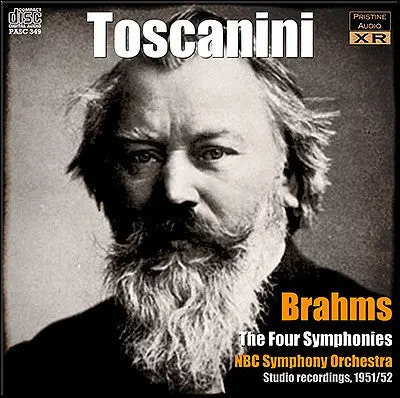
BRAHMS Symphony No. 1
BRAHMS Symphony No. 2
BRAHMS Symphony No. 3
BRAHMS Symphony No. 4
Recorded in 1951 and 1952
Total duration: 2hr 36:17
NBC Symphony Orchestra
Arturo Toscanini, conductor
578a9379d1e540bd96d26f03a79628d9review_titlefb55cd020f0643f08418183279e63a5fMusicWeb International Review578a9379d1e540bd96d26f03a79628d9review_quotefb55cd020f0643f08418183279e63a5fThere is a massive exuberance, following the pattern we have seen in Toscanini’s love-affair with Brahms578a9379d1e540bd96d26f03a79628d9review_bodyfb55cd020f0643f08418183279e63a5f
The best news here is that as well as illuminating the sound ingeneral, Pristine engineer Andrew Rose has been able to enhance thepreviously inferior sound for the Third and Fourth symphonies so that itmatches that of the first two. Their better recorded sound explains why theFirst and Second Symphonies have long been available and very recommendableto anyone tolerant of mono. Now all four symphonies have some air aroundthem, the glare and harshness tamed and erratic pitch corrected. They arestill no aural feast but as with the Pristine re-mastering ofFurtwängler’s Brahms from the 1940s and 1950s, the obviousperformances for purposes of comparison, a new depth and spaciousness havebeen revealed and the listener’s enjoyment of the very differentapproach to Brahms by both maestros has been enormously enhanced.
Furtwängler’s interpretation is generally much warmer and more Romantic than Toscanini’s but there is certainly no lack of feeling in the latter’s Andantes and Adagios, even though he is on average some two minutes faster than Furtwängler. However, the default position criticism of Toscanini – “he conducts everything at breakneck speed” – hardly applies here, even if it is true that he takes the opening to the First faster than any other conductor I know. As is often the case when re-encountering Toscanini after listening to more modern or later accounts of Brahms symphonies by Abbado and Karajan, my first thoughts were that he was rather perfunctory and unyielding – but the ear soon adjusts to what he is about. Once the second subject of the magical Andante second movement in the First Symphony spirals heavenward on soaring strings, you know that you are safe in the hands of a master Brahms interpreter. It is possible to miss the depth of sound we enjoy in those more recent recordings but Toscanini’s insistence upon individual instrumental lines emerging clearly pays dividends; one hears harmonic details and nuances you do not always catch in warmer, stereo sound. He is never speedy for its own sake; his direction is always taut and purposeful, his frequent use of ritenuto judicious and his phrasing sublime: the dotted second subject in the Andante sostenuto in the First Symphony really sings, helped by the sweetness of the solo by the NBC’s first violinist and the sonority of the contribution of the principal horn. There is often a kind of febrile joy in Toscanini’s music-making which sweeps the listener along; thus the Scherzo is breathless but exhilarating – more “allegro” than a true “allegretto” – but it works. Not that Toscanini cannot plumb the depths; there is a brooding majesty to the Adagio opening of the fourth movement, as a bemired C minor struggles to emerge into the sunlit uplands of C major via those plangent horn and flute solos and the Big Tune builds massively to an explosive finale which is simply glorious with its uplifting, climactic chorale.
Probably recognising Brahms’ reference to his symphony no.2 as“elegiac and melancholy” as another of the sardoniccomposer’s little ironic jokes, Toscanini eschews the dragginess whichafflicts recordings by such as Giulini and refuses to linger. He does notreplicate the fluidity that Karajan achieves, or the melodramatic“Sturm und Drang” approach of Furtwängler, or the darkwarmth of Klemperer but, surprisingly, instead, aims for charm, againphrasing gorgeously, catching Brahms’ Alpine holiday mood. The finaleis a little breathless and frenetic but Toscanini relaxes for the secondvariation and eventually steers us home in the most exhilarating fashionimaginable without adopting an especially fast tempo.
The Third is in many ways the most straightforward of Brahms’symphoniesand elicits the most relaxed of Toscanini’s interpretations. He bringsaconfident swing to the frequent, swaying three-quarter-time rhythms whichrunthroughout this symphony. Toscanini maintains a gentle pulse, movinginexorablytowards a grand finale which is another of Brahms’ trademarks. TheAndantefinds Toscanini at his most genial, hence he is even slower thanFurtwängler,Levine, Abbado and van Zweden. Then in the finale all that restraint isthrownaside for a rip-roaring Allegro before the return to serenity.
“Relaxed” is not the first word we usually apply to thisconductor, but the Fourth again finds him effortlessly synthesising theplethora of ideas based around the interval of a third that flood this mostmusically fertile of Brahms’ symphonies. There is a massive exuberanceabout the conclusion, following the pattern we have seen inToscanini’s love-affair with Brahms. Technically, there are someproblems in the synchronisation between the violins and the rest of theorchestra, symptomatic of the sense of urgency characteristic of Toscanini’s typical forward momentum.
Ralph Moore
578a9379d1e540bd96d26f03a79628d9main_samplefb55cd020f0643f08418183279e63a5fsamples/PASC349.mp3578a9379d1e540bd96d26f03a79628d9tab1_labelfb55cd020f0643f08418183279e63a5fProducer’s Note578a9379d1e540bd96d26f03a79628d9tab1_typefb55cd020f0643f08418183279e63a5fcontent578a9379d1e540bd96d26f03a79628d9tab1_contentfb55cd020f0643f08418183279e63a5f
Toscanini’s “ardent, blazing performances” of the complete Brahms Symphonies
New XR remasters have completely revitalised the sound of these masterworks
It comes as no surprise to find Toscanini’s studio LP recordings of Brahms’ four symphonies still in RCA’s catalogue. Alas the sound quality , whilst adequate for the first two symphonies, slips dramatically for the Third and Fourth, and all have anomalies throughout. This remastering aims to set the balance straight, to raise first the sound quality of Symphonies 1 and 2, and then to bring Symphonies 3 and 4 up to this same new standard. Careful application of the XR remastering system has achieved this and more – Toscanini’s magnificent recordings of the Brahms symphonic canon have never sounded as wonderful as this!
I’ve also been able to fix some pitch anomalies, most acute in the Third Symphony, where both the second half of the 1st movement and the entire finale were considerably sharp.
Andrew Rose
578a9379d1e540bd96d26f03a79628d9tab1_cover_thumbnail1_s3_locationfb55cd020f0643f08418183279e63a5f578a9379d1e540bd96d26f03a79628d9tab1_cover_thumbnail2_s3_locationfb55cd020f0643f08418183279e63a5f578a9379d1e540bd96d26f03a79628d9tab1_cover_download_s3_locationfb55cd020f0643f08418183279e63a5f578a9379d1e540bd96d26f03a79628d9tab1_sample1_s3_locationfb55cd020f0643f08418183279e63a5f578a9379d1e540bd96d26f03a79628d9tab1_sample2_s3_locationfb55cd020f0643f08418183279e63a5f578a9379d1e540bd96d26f03a79628d9tab1_sample3_s3_locationfb55cd020f0643f08418183279e63a5f578a9379d1e540bd96d26f03a79628d9tab1_sample4_s3_locationfb55cd020f0643f08418183279e63a5f578a9379d1e540bd96d26f03a79628d9tab1_sample5_s3_locationfb55cd020f0643f08418183279e63a5f578a9379d1e540bd96d26f03a79628d9tab1_sample6_s3_locationfb55cd020f0643f08418183279e63a5f578a9379d1e540bd96d26f03a79628d9tab2_labelfb55cd020f0643f08418183279e63a5fFull Track Listing578a9379d1e540bd96d26f03a79628d9tab2_typefb55cd020f0643f08418183279e63a5ftrack_listing578a9379d1e540bd96d26f03a79628d9tab2_contentfb55cd020f0643f08418183279e63a5f
- BRAHMS Symphony No. 1 in C minor, Op. 68
- BRAHMS Symphony No. 2 in D major, Op. 73
- BRAHMS Symphony No. 3 in F major, Op. 90
- BRAHMS Symphony No. 4 in E minor, Op. 98
NBC Symphony Orchestra
Arturo Toscanini conductor
Recorded at Carnegie Hall, New York City
Symphony No. 1
Recorded 6 November 1951
First issued as RCA LM-1702
Symphony No. 2
Recorded 11 February 1952
First issued as RCA LM-1731
Symphony No. 3
Recorded 4 November 1952
First issued as RCA LM-1836
Symphony No. 4
Recorded 3 December 1951
First issued as RCA LM-1713
XR remastering by Andrew Rose at Pristine Audio, June 2012
Cover artwork based on a photograph of Brahms
Total duration: 2hr 36:17
578a9379d1e540bd96d26f03a79628d9tab2_cover_thumbnail1_s3_locationfb55cd020f0643f08418183279e63a5f578a9379d1e540bd96d26f03a79628d9tab2_cover_thumbnail2_s3_locationfb55cd020f0643f08418183279e63a5f578a9379d1e540bd96d26f03a79628d9tab2_cover_download_s3_locationfb55cd020f0643f08418183279e63a5f578a9379d1e540bd96d26f03a79628d9tab2_sample1_s3_locationfb55cd020f0643f08418183279e63a5f578a9379d1e540bd96d26f03a79628d9tab2_sample2_s3_locationfb55cd020f0643f08418183279e63a5f578a9379d1e540bd96d26f03a79628d9tab2_sample3_s3_locationfb55cd020f0643f08418183279e63a5f578a9379d1e540bd96d26f03a79628d9tab2_sample4_s3_locationfb55cd020f0643f08418183279e63a5f578a9379d1e540bd96d26f03a79628d9tab2_sample5_s3_locationfb55cd020f0643f08418183279e63a5f578a9379d1e540bd96d26f03a79628d9tab2_sample6_s3_locationfb55cd020f0643f08418183279e63a5f578a9379d1e540bd96d26f03a79628d9tab3_labelfb55cd020f0643f08418183279e63a5fCover Art578a9379d1e540bd96d26f03a79628d9tab3_typefb55cd020f0643f08418183279e63a5fcover_art578a9379d1e540bd96d26f03a79628d9tab3_contentfb55cd020f0643f08418183279e63a5f578a9379d1e540bd96d26f03a79628d9tab3_cover_thumbnail1_s3_locationfb55cd020f0643f08418183279e63a5fcovers/thumbs/PASC349.jpg578a9379d1e540bd96d26f03a79628d9tab3_cover_thumbnail2_s3_locationfb55cd020f0643f08418183279e63a5f578a9379d1e540bd96d26f03a79628d9tab3_cover_download_s3_locationfb55cd020f0643f08418183279e63a5fcovers/PASC349.pdf578a9379d1e540bd96d26f03a79628d9tab3_sample1_s3_locationfb55cd020f0643f08418183279e63a5f578a9379d1e540bd96d26f03a79628d9tab3_sample2_s3_locationfb55cd020f0643f08418183279e63a5f578a9379d1e540bd96d26f03a79628d9tab3_sample3_s3_locationfb55cd020f0643f08418183279e63a5f578a9379d1e540bd96d26f03a79628d9tab3_sample4_s3_locationfb55cd020f0643f08418183279e63a5f578a9379d1e540bd96d26f03a79628d9tab3_sample5_s3_locationfb55cd020f0643f08418183279e63a5f578a9379d1e540bd96d26f03a79628d9tab3_sample6_s3_locationfb55cd020f0643f08418183279e63a5f578a9379d1e540bd96d26f03a79628d9tab4_labelfb55cd020f0643f08418183279e63a5fHistoric Reviews578a9379d1e540bd96d26f03a79628d9tab4_typefb55cd020f0643f08418183279e63a5fcontent578a9379d1e540bd96d26f03a79628d9tab4_contentfb55cd020f0643f08418183279e63a5f
REVIEW – complete Brahms Symphonies
The reappearance of Toscanini’s recordings of all the Brahms symphonies on the R.C.A. label is a most welcome event, for they should never be unavailable. As commercial ramifications are the only reason for their ever being off the market I had intended to give them what I believe is called in book circles a “reviewer’s reading”, a skim through. But, started on the first, I could not leave these ardent, blazing performances alone. They are wonderful and it is certain that, whatever the claims of other conductors, no Brahms lover should be without these. On their new label they sound very well and one need not fear the unpleasant sound associated with many Toscanini recordings, only the 3rd being less good…
T.H. The Gramophone, May 1959 (Reviewing R.C.A. RB16097-16100, LP reissues, excerpt)
REVIEW – Symphonies 1 & 2
As a second-best for those unable to hear Toscanini’s “live” performances of the Brahms symphonies in the Royal Festival Hall, which will have taken place by the time these words appear—and as a permanent reminder for the fortunate others—these records should have a considerable appeal. When they were made I do not know, but despite the great man’s advancing years they are as full of fire and finesse as ever. (I am irresistibly reminded of Widor, at the age of nearly ninety, ripping his way through the finale of his Fifth Symphony for H.M.V.). The meticulous care over every detail, the beautiful phrasing and the breadth of line, the rhythmic bite, are hallmarks of the master. It has been claimed that, as an Italian, Toscanini is not the ideal interpreter of Brahms’ typically Teutonic genius; but the Second Symphony elicits from him a perfectly appropriate lyricism, and there is not the smallest suggestion of stylistic impropriety in the more virile First. Besides, remembering Furtwängler’s wilful exaggerations, is the German spirit necessarily more en rapport? There are, needless to say, none of these distortions here, but instead a choice of tempi which is made to seem inevitable: I would draw attention to the perfect tempo-transitions in the third movement of No. 2. The “bell-chime” horn tune and the trombones’ chorale-like passage in the finale of No. 1 are taken slower than usual, and later in the movement the speeds do vary somewhat, but there is the evidence of Brahms’ markings to justify this. In the orchestra’s playing there is much of great beauty—I instance the glowing ‘cello tone in the Adagio of No. 2 and the truly sotto voce quality of the start of the finale; and indeed the only real flaw I can find anywhere is the out-of-tune held A on trumpet and horn at the close of the first movement of the same symphony. Students of Brahms’ scores will notice with interest that in No. 1 Toscanini suppresses the viola-and-timpani triplets at the two breakoffs a couple of dozen bars before the end.
On the technical side these issues are less satisfactory, though never enough seriously to detract from appreciation of the music. The worst fault for me is the extremely sharp pitch at which both works are recorded—I cannot get used to a Brahms’ symphony in D sharp—but others without perfect pitch may not be worried by this. I suspect, however, that the consequent increase in speed may be partly responsible for the metallic tone of the strings (the wood-wind suffer less). The quality in general is rather coarse and thick, particularly in forte sections (e.g., in the Allegretto of No. 1 and the finale of No. 2); and the engineers seem to have been reluctant to allow a true p or pp level: the solo violin in the Andante of the First Symphony has been unduly amplified. In the SP version of No. 2 there is an overlap of four bars on the change-over from side 1 to side 2, and of three bars from side 7 to side 8; and in the first movement of No. 1 the gap between sides 2 and 3 comes just at that dramatic change of harmony between the chords of G7 and the 6-4 of B minor, so that Brahms’ effect is lost. In these regards, at any rate, the LP issue which is promised is bound to be an improvement.
L.S. The Gramophone, October 1952 (Reviewing HMV 78rpm issues)
578a9379d1e540bd96d26f03a79628d9tab4_cover_thumbnail1_s3_locationfb55cd020f0643f08418183279e63a5f578a9379d1e540bd96d26f03a79628d9tab4_cover_thumbnail2_s3_locationfb55cd020f0643f08418183279e63a5f578a9379d1e540bd96d26f03a79628d9tab4_cover_download_s3_locationfb55cd020f0643f08418183279e63a5f578a9379d1e540bd96d26f03a79628d9tab4_sample1_s3_locationfb55cd020f0643f08418183279e63a5f578a9379d1e540bd96d26f03a79628d9tab4_sample2_s3_locationfb55cd020f0643f08418183279e63a5f578a9379d1e540bd96d26f03a79628d9tab4_sample3_s3_locationfb55cd020f0643f08418183279e63a5f578a9379d1e540bd96d26f03a79628d9tab4_sample4_s3_locationfb55cd020f0643f08418183279e63a5f578a9379d1e540bd96d26f03a79628d9tab4_sample5_s3_locationfb55cd020f0643f08418183279e63a5f578a9379d1e540bd96d26f03a79628d9tab4_sample6_s3_locationfb55cd020f0643f08418183279e63a5f
Explore more from our collection.



Reviews
There are no reviews yet.