Description
overviewfb55cd020f0643f08418183279e63a5f
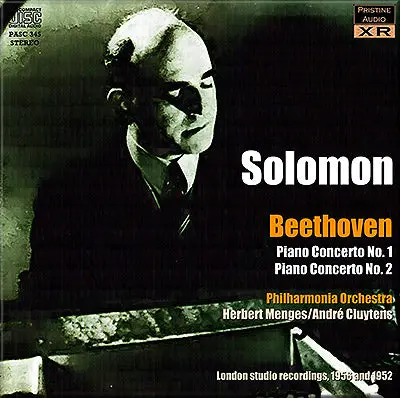
BEETHOVEN Piano Concerto No. 1
BEETHOVEN Piano Concerto No. 2
Recorded in 1956 and 1952
Total duration: 62:23
Solomon, piano
The Philharmonia Orchestra
conductors Herbert Menges, André Cluytens
578a9379d1e540bd96d26f03a79628d9review_titlefb55cd020f0643f08418183279e63a5fClassical CD Review review578a9379d1e540bd96d26f03a79628d9review_quotefb55cd020f0643f08418183279e63a5fSolomon’s interpretations of both concerti have become my new favorites578a9379d1e540bd96d26f03a79628d9review_bodyfb55cd020f0643f08418183279e63a5f
Beautiful, beautiful, beautiful. The English pianist Solomon, as he billed himself professionally, has flown mostly under the radar of classical-music lovers outside Britain. I’m not sure why, although this situation has recently begun to undergo correction. Perhaps his obscurity stems from the stroke he suffered in 1956, which froze his right arm. Although he lived another 32 years, he never performed in public again. During his absence, other pianists came to notice, and the lack of Solomon recordings in new formats put him further in the shade.
I first heard him in his classic recording of the Arthur Bliss Piano Concerto.It didn’t impress me, but my dissatisfaction arose from the piece itself as wellas from the muddy EMI sound. The Beethoven recordings issuedby Pristine reveal one of the finest pianists of the previous century and oneof the great Beethoven pianists, period.
It so happens that Beethoven’s first piano concerto (EMI, withSchnabel and Sargent) introduced me to the cycle. Up until I heard Solomon, Schnabel’swas my favorite performance. The two earliest piano concerti don’t get the respectof the latter three, but those three blaze new trails. One could trace almostthe rest of the Nineteenth Century’s piano concerti to one of them — the Schumannto No. 4, the Brahms to No. 3, the Tchaikovsky to No. 5, for example. However,numbers 1 and 2 represent supreme examples of the Mozartean concerto, particularlythe “martial” concerto. Mozart wrote many different kinds of concerto– martial, pastorale, buffa, and so on — but Beethoven pretty much stuck tothe one subgenre, although he expanded its musical and expressive range. ConcertoNo. 1 (actually written after the designated second) asks the question, “What’snot to like?” Its witty outer movements brim full of surprising turns andthemes of high invention, a bit like Papageno’s music in Zauberflöte,while the stunning largo ponders, to paraphrase Blake, eternity in a moment –the mood of the slow movement of Mozart’s Concerto No. 21. Although more tightlybound to the immediate past, Concerto No. 2 nevertheless revealed Beethoven asthe composer to watch. The themes follow classical models more closely, but Beethovenkicks them over like sand castles in his treatment of them, as early as the firstparagraph of the first movement. He breaks up the boxiness of the phrasing notonly with rough syncopation but with wild modulations to distant keys. The secondmovement strikes me as a rehearsal of the largo of the official First, a “pathetic” operaaria for piano and a good example of its type, but without the latter’s specialtranscendence. The third movement rondo is a symphonic view-halloo, a rapturousride through the pastoral landscape. Based on what Solomon does in these twoworks, you can safely bet that his Mozart will be wonderful as well.
Let me say first that Solomon’s interpretations of both concerti have becomemy new favorites, surpassing even the Schnabel/Sargent No. 1. He gives both aMozartean elegance, with a beauty of tone that out-pretties Van Cliburn in theTchaikovsky, while maintaining a profound understanding of what he plays. Histouch is yummy, his runs like perfect little diamonds. A superb concerto partner,he always occupies the most appropriate place in the texture, but he also standsout in the concerti’s cadenzas, especially that of the Second’s first movement– a fugato, composed years after the concerto itself, and thus perhaps a bitjarring. It would be picky to complain, however. It’s almost a sonata movementin itself, with a wonderful idea that reminds me of Wile E. Coyote spasmodicallyscrabbling for a hold in thin air as he falls the usual impossible distance.
However, a great concerto performance means to me a great partnership betweensolo and orchestra. Herbert Menges seems to me a great conductor overlooked amongthe talent in England. He matches Solomon elegant point for elegant point inthe Concerto No. 1. André Cluytens is bit looser, but perhaps a bit warmeras well. On the other hand, Menges has the advantage of a beautifully clear stereoimage. Unfortunately, stereo came in at the end of Solomon’s career. There can’tbe many more such recordings. In the weeks to come, however, I will review Pristine’scomplete Solomon-Beethoven concerto cycle.
Andrew Rose has made it Pristine‘s mission to offer recordingsof historically-important recordings in the best possible sound. The stereo EMI recordinghas been restored to probably better-than-new, while the mono Second Concertoavoids the flat tinny-ness associated with “historical” recordings.It sings, as I have hinted, in a warm, round tone.
S.G.S. (January 2014)
578a9379d1e540bd96d26f03a79628d9main_samplefb55cd020f0643f08418183279e63a5fsamples/PASC345.mp3578a9379d1e540bd96d26f03a79628d9tab1_labelfb55cd020f0643f08418183279e63a5fProducer’s Note578a9379d1e540bd96d26f03a79628d9tab1_typefb55cd020f0643f08418183279e63a5fcontent578a9379d1e540bd96d26f03a79628d9tab1_contentfb55cd020f0643f08418183279e63a5f
The Early Beethoven Piano Concerto recordings from Solomon
These new remasters unveil superb sound quality in both recordings
These two recordings, made just four years apart, seemed on first hearing to belong to different eras. The stereo 1956 recording of the Concerto No. 1 was excellently made; this remastering serves only to enhance an already fine sound and breathe a little more life into it. By contrast the 1952 Concerto No. 2, made at Kingsway Hall rather than Abbey Road, has been greatly revived from its dim and dull origins, and cured of the majority of the flaws identified in its first review in 1953 as a result.
I’ve also been able to cure the wow and flutter issues referred to in the review, and despite the mono sound, this Ambient Stereo presentation, retaining the central mono image but allowing reverberant space around the performers, goes along way to bringing the older recording up toward the very high technical standards set by the first concerto.
Andrew Rose
578a9379d1e540bd96d26f03a79628d9tab1_cover_thumbnail1_s3_locationfb55cd020f0643f08418183279e63a5f578a9379d1e540bd96d26f03a79628d9tab1_cover_thumbnail2_s3_locationfb55cd020f0643f08418183279e63a5f578a9379d1e540bd96d26f03a79628d9tab1_cover_download_s3_locationfb55cd020f0643f08418183279e63a5f578a9379d1e540bd96d26f03a79628d9tab1_sample1_s3_locationfb55cd020f0643f08418183279e63a5f578a9379d1e540bd96d26f03a79628d9tab1_sample2_s3_locationfb55cd020f0643f08418183279e63a5f578a9379d1e540bd96d26f03a79628d9tab1_sample3_s3_locationfb55cd020f0643f08418183279e63a5f578a9379d1e540bd96d26f03a79628d9tab1_sample4_s3_locationfb55cd020f0643f08418183279e63a5f578a9379d1e540bd96d26f03a79628d9tab1_sample5_s3_locationfb55cd020f0643f08418183279e63a5f578a9379d1e540bd96d26f03a79628d9tab1_sample6_s3_locationfb55cd020f0643f08418183279e63a5f578a9379d1e540bd96d26f03a79628d9tab2_labelfb55cd020f0643f08418183279e63a5fFull Track Listing578a9379d1e540bd96d26f03a79628d9tab2_typefb55cd020f0643f08418183279e63a5ftrack_listing578a9379d1e540bd96d26f03a79628d9tab2_contentfb55cd020f0643f08418183279e63a5f
- BEETHOVEN Piano Concerto No. 1 in C major, Op. 15
Transfer from EMI HLS 7067
Recorded 16 September 1956
at Abbey Road Studio 1, London
First issued as HMV ASD.294
Stereo recording - BEETHOVEN Piano Concerto No. 2 in B flat major, Op. 19
Transfer from EMI HLS 7067/8
Recorded 2 November 1952
at Kingsway Hall, London
First issued as HMV BLP.1024
Mono recording
Presented in Ambient Stereo
Solomon piano
The Philharmonia Orchestra
Herbert Menges conductor, Concerto No. 1
André Cluytens conductor, Concerto No. 2
XR remastering by Andrew Rose at Pristine Audio, June 2012
Cover artwork based on a photograph of Solomon
Total duration: 62:23
578a9379d1e540bd96d26f03a79628d9tab2_cover_thumbnail1_s3_locationfb55cd020f0643f08418183279e63a5f578a9379d1e540bd96d26f03a79628d9tab2_cover_thumbnail2_s3_locationfb55cd020f0643f08418183279e63a5f578a9379d1e540bd96d26f03a79628d9tab2_cover_download_s3_locationfb55cd020f0643f08418183279e63a5f578a9379d1e540bd96d26f03a79628d9tab2_sample1_s3_locationfb55cd020f0643f08418183279e63a5f578a9379d1e540bd96d26f03a79628d9tab2_sample2_s3_locationfb55cd020f0643f08418183279e63a5f578a9379d1e540bd96d26f03a79628d9tab2_sample3_s3_locationfb55cd020f0643f08418183279e63a5f578a9379d1e540bd96d26f03a79628d9tab2_sample4_s3_locationfb55cd020f0643f08418183279e63a5f578a9379d1e540bd96d26f03a79628d9tab2_sample5_s3_locationfb55cd020f0643f08418183279e63a5f578a9379d1e540bd96d26f03a79628d9tab2_sample6_s3_locationfb55cd020f0643f08418183279e63a5f578a9379d1e540bd96d26f03a79628d9tab3_labelfb55cd020f0643f08418183279e63a5fCover Art578a9379d1e540bd96d26f03a79628d9tab3_typefb55cd020f0643f08418183279e63a5fcover_art578a9379d1e540bd96d26f03a79628d9tab3_contentfb55cd020f0643f08418183279e63a5f578a9379d1e540bd96d26f03a79628d9tab3_cover_thumbnail1_s3_locationfb55cd020f0643f08418183279e63a5fcovers/thumbs/PASC345.jpg578a9379d1e540bd96d26f03a79628d9tab3_cover_thumbnail2_s3_locationfb55cd020f0643f08418183279e63a5f578a9379d1e540bd96d26f03a79628d9tab3_cover_download_s3_locationfb55cd020f0643f08418183279e63a5fcovers/PASC345.pdf578a9379d1e540bd96d26f03a79628d9tab3_sample1_s3_locationfb55cd020f0643f08418183279e63a5f578a9379d1e540bd96d26f03a79628d9tab3_sample2_s3_locationfb55cd020f0643f08418183279e63a5f578a9379d1e540bd96d26f03a79628d9tab3_sample3_s3_locationfb55cd020f0643f08418183279e63a5f578a9379d1e540bd96d26f03a79628d9tab3_sample4_s3_locationfb55cd020f0643f08418183279e63a5f578a9379d1e540bd96d26f03a79628d9tab3_sample5_s3_locationfb55cd020f0643f08418183279e63a5f578a9379d1e540bd96d26f03a79628d9tab3_sample6_s3_locationfb55cd020f0643f08418183279e63a5f578a9379d1e540bd96d26f03a79628d9tab4_labelfb55cd020f0643f08418183279e63a5fHistoric Reviews578a9379d1e540bd96d26f03a79628d9tab4_typefb55cd020f0643f08418183279e63a5fcontent578a9379d1e540bd96d26f03a79628d9tab4_contentfb55cd020f0643f08418183279e63a5f
Review (Concerto No. 1)
It may be that Solomon gives slightly the more elegant performance of the concerto, Rubinstein slightly the more powerful. But it is quite Certainly the case that both solo performances are in the very first class; less certainly the case that both orchestral performances are, for the New York orchestra does here and there lack something of both the poetry and the precision the Philharmonia do unfailingly bring to the music.
A predisposition on these grounds in favour of the H.M.V. version is further strengthened on consideration of other factors; for though both stereo records offer excellent sound in the quieter passages of the music, the fuller tuttis are more richly as well as more clearly handled by the H.M.V. Both soloists use Beethoven’s own cadenzas to the first movement: Rubinstein a version of No. 3, Solomon No. 2, which I hope it will not seem too much of a backhanded compliment to say has the great advantage of being very much shorter. If any further evidence is needed before making a choice, consider H.M.V’s bonus, surely a convincing one: Solomon giving a serene performance, beautifully recorded, of the Beethoven late E minor piano sonata. Choice, indeed, seems to me to be selfevident; but this is most certainly not to deny the many beauties of the Rubinstein performance.
M.M., The Gramophone, December 1959
Review (Concerto No. 2)
Any new recording of the B fiat Concerto actually the first of Beethoven’s five for piano, despite its numbering — is up against stiff competition from the Decca version by Backhaus and the Vienna Phil, which M.M. praised in the February issue for its sobriety, its avoidance of any striving after effect, and its fine full recording. I fully agree with his assessment of that disc, though he did not mention two details in the first movement which worried me — the sudden spurt in tempo at the development, and the flatter pitch of the (obviously inserted) cadenza. Solomon, while still making it clear that this is early Beethoven and not Mozart, takes the work less weightily, with what might almost be thought a “period” sense of proportion. The first movement is taken rather faster than in the Decca issue, and both soloist and orchestra give us admirably alert playing which stresses the con brio part of the tempo-indication. This care over authentic tempi i- observed again in the following movement, which already, in this his first major orchestral work, foreshadows Beethoven’s later “pathetic” style; the slow speed adopted is a true Adagio. It is unfortunate that the recording does not match the quality of the performance: the orchestral opening is rather flimsy in tone, and the piano’s first entry sounds almost as if its microphone is not properly “up” — in general, indeed, the soloist seems rather distant, and he is at times almost concealed by the strings. In the cadenza there is some distortion, while in forte passages of the Adagio the tone is c.ongested, and long sustained piano notes suffer a faint but persistent “wow”. A pity, for this is a performance worth better presentation.
L.S., The Gramophone, September 1953
578a9379d1e540bd96d26f03a79628d9tab4_cover_thumbnail1_s3_locationfb55cd020f0643f08418183279e63a5f578a9379d1e540bd96d26f03a79628d9tab4_cover_thumbnail2_s3_locationfb55cd020f0643f08418183279e63a5f578a9379d1e540bd96d26f03a79628d9tab4_cover_download_s3_locationfb55cd020f0643f08418183279e63a5f578a9379d1e540bd96d26f03a79628d9tab4_sample1_s3_locationfb55cd020f0643f08418183279e63a5f578a9379d1e540bd96d26f03a79628d9tab4_sample2_s3_locationfb55cd020f0643f08418183279e63a5f578a9379d1e540bd96d26f03a79628d9tab4_sample3_s3_locationfb55cd020f0643f08418183279e63a5f578a9379d1e540bd96d26f03a79628d9tab4_sample4_s3_locationfb55cd020f0643f08418183279e63a5f578a9379d1e540bd96d26f03a79628d9tab4_sample5_s3_locationfb55cd020f0643f08418183279e63a5f578a9379d1e540bd96d26f03a79628d9tab4_sample6_s3_locationfb55cd020f0643f08418183279e63a5f
Explore more from our collection.


Reviews
There are no reviews yet.