Description
overviewfb55cd020f0643f08418183279e63a5f
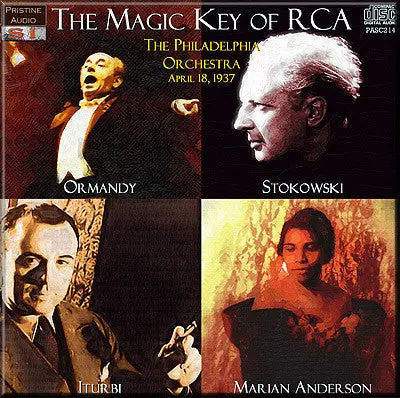
THE MAGIC KEY OF RCA
Marian Anderson – contralto
José Iturbi – conductor, solo piano
The Philadelphia Orchestra
Charles O’Connell – conductor, arranger
Eugene Ormandy – conductor
Leopold Stokowski – conductor, arranger
Recorded 1937
Total duration: 59:36
578a9379d1e540bd96d26f03a79628d9review_titlefb55cd020f0643f08418183279e63a5f578a9379d1e540bd96d26f03a79628d9review_quotefb55cd020f0643f08418183279e63a5f578a9379d1e540bd96d26f03a79628d9review_bodyfb55cd020f0643f08418183279e63a5f578a9379d1e540bd96d26f03a79628d9main_samplefb55cd020f0643f08418183279e63a5fsamples/PASC214.mp3578a9379d1e540bd96d26f03a79628d9tab1_labelfb55cd020f0643f08418183279e63a5fProducer’s Note578a9379d1e540bd96d26f03a79628d9tab1_typefb55cd020f0643f08418183279e63a5fcontent578a9379d1e540bd96d26f03a79628d9tab1_contentfb55cd020f0643f08418183279e63a5f
A stellar line-up for a truly “Magic” hour of radio
Launching the Pristine Audio “SI” – Special Interest – historic series
The Magic Key of RCA ran as an hour-long musical variety programme on an almost-weekly basis for 204 episodes over four years, between 29th September 1935 and 18th September 1939. The broadcasts went out on Sunday afternoons between 2pm and 3pm on NBC’s Blue network, and featured a very wide range of artists and guests – the very first broadcast, for example, included contributions not only from conductor Walter Damrosch and singer Paul Whiteman, but also Walt Disney and radio comedians Amos ‘n’ Andy.
The 79th broadcast of 18th April 1937 came live from the Philadelphia Academy of Music, on the eve of the Philadelphia Orchestra’s five-week “coast-to-coast tour of 11,000 miles with stops at twenty-four cities” under Ormandy and Iturbi, travelling on a “special de-luxe 9-car Pullman train”. The broadcast carefully promotes not only the tour, but also RCA Victor’s long association with the orchestra, and of course RCA’s own electrical products.
In fact the “Magic Key” series came about as a means of promoting an electronic tuning aid developed by RCA for its radios in 1935, and was one of a number of ‘magic’ references dreamed up by RCA’s PR department, as this excerpt from a technical website makes clear:
RCA registered their first electron-ray tube, the 6E5, on June 27, 1935. This tube initially appeared in RCA’s console-model product line that same year. RCA was fearing a loss of market share to competitors’ new lines of very small and midget radios, many of which were designed and produced in Los Angeles. RCA’s promotion touted the “Magic Eye” as an elegant feature of their upper product line – where profit margins were greatest. Not surprisingly, the 6E5 wouldn’t fit inside the competitors’ smallest sets. The name “Magic Eye” quickly gained acceptance with the public as the standard identity for the electron ray tube and tuning eye feature in consumer radio sets, regardless of manufacturer.
RCA’s marketing department went on a bit of a binge with the “Magic” theme as it popped up in a variety of other radio features. This included the “Magic Brain” tuning unit, the “Magic Voice” sound system, the “Magic Wave” antenna, and the “Magic Key” station programming system. Two of RCA’s 1936 model year console sets introduced in late 1935, Models 9K and 13K, were really “Magic”. Along with the “Magic Eye”, they were equipped with a combination of the other “Magic” features. The public however was not as impressed with these other “Magic” promotions as none of them gained the lasting familiarity of the “Magic Eye.”
A Pristine Audio SI Release: Technical Note
The source recording for this release, supplied to me by Edward Johnson of the Stokowski Society, appeared to have originated from an AM broadcast recording captured on acetate discs.However, it had already received some quite strong noise processing which I was unable to undo, hence the release’s designation as an “SI” release, meaning of “Special Interest” – but of reduced fidelity.
It has been fully restored and XR-remastered, greatly improving the sound quality over the original as supplied, but several aspects of the audio had already been compromised beyond restoration. We believe that, for many collectors, this will prove secondary to simply having this remarkable recording available to listen to.
Pristine Audio SI releases, although processed at 32-bit or higher resolution, are not available as 24-bit downloads as there is no sonic improvement possible over the standard 16-bit versions of these issues.
Andrew Rose
578a9379d1e540bd96d26f03a79628d9tab1_cover_thumbnail1_s3_locationfb55cd020f0643f08418183279e63a5f578a9379d1e540bd96d26f03a79628d9tab1_cover_thumbnail2_s3_locationfb55cd020f0643f08418183279e63a5f578a9379d1e540bd96d26f03a79628d9tab1_cover_download_s3_locationfb55cd020f0643f08418183279e63a5f578a9379d1e540bd96d26f03a79628d9tab1_sample1_s3_locationfb55cd020f0643f08418183279e63a5f578a9379d1e540bd96d26f03a79628d9tab1_sample2_s3_locationfb55cd020f0643f08418183279e63a5f578a9379d1e540bd96d26f03a79628d9tab1_sample3_s3_locationfb55cd020f0643f08418183279e63a5f578a9379d1e540bd96d26f03a79628d9tab1_sample4_s3_locationfb55cd020f0643f08418183279e63a5f578a9379d1e540bd96d26f03a79628d9tab1_sample5_s3_locationfb55cd020f0643f08418183279e63a5f578a9379d1e540bd96d26f03a79628d9tab1_sample6_s3_locationfb55cd020f0643f08418183279e63a5f578a9379d1e540bd96d26f03a79628d9tab2_labelfb55cd020f0643f08418183279e63a5fFull Track Listing578a9379d1e540bd96d26f03a79628d9tab2_typefb55cd020f0643f08418183279e63a5ftrack_listing578a9379d1e540bd96d26f03a79628d9tab2_contentfb55cd020f0643f08418183279e63a5f
Introduction (Milton Cross)
The Philadelphia Orchestra
Marian Anderson – contralto
José Iturbi – conductor, solo piano
Charles O’Connell – conductor, arranger
Eugene Ormandy – conductor
Leopold Stokowski – conductor, arranger
Programme introduced by Milton Cross and Ben Grauer
Broadcast from The Philadelphia Academy of Music, 2-3pm EST, Sunday 18th April, 1937, on NBC Blue Network
XR remastering by Andrew Rose at Pristine Audio, February 2010
Cover artwork based on photographs of Ormandy, Stokowski, Iturbi & Andersom
Total duration: 59:36
578a9379d1e540bd96d26f03a79628d9tab2_cover_thumbnail1_s3_locationfb55cd020f0643f08418183279e63a5f578a9379d1e540bd96d26f03a79628d9tab2_cover_thumbnail2_s3_locationfb55cd020f0643f08418183279e63a5f578a9379d1e540bd96d26f03a79628d9tab2_cover_download_s3_locationfb55cd020f0643f08418183279e63a5f578a9379d1e540bd96d26f03a79628d9tab2_sample1_s3_locationfb55cd020f0643f08418183279e63a5f578a9379d1e540bd96d26f03a79628d9tab2_sample2_s3_locationfb55cd020f0643f08418183279e63a5f578a9379d1e540bd96d26f03a79628d9tab2_sample3_s3_locationfb55cd020f0643f08418183279e63a5f578a9379d1e540bd96d26f03a79628d9tab2_sample4_s3_locationfb55cd020f0643f08418183279e63a5f578a9379d1e540bd96d26f03a79628d9tab2_sample5_s3_locationfb55cd020f0643f08418183279e63a5f578a9379d1e540bd96d26f03a79628d9tab2_sample6_s3_locationfb55cd020f0643f08418183279e63a5f578a9379d1e540bd96d26f03a79628d9tab3_labelfb55cd020f0643f08418183279e63a5fCover Art578a9379d1e540bd96d26f03a79628d9tab3_typefb55cd020f0643f08418183279e63a5fcover_art578a9379d1e540bd96d26f03a79628d9tab3_contentfb55cd020f0643f08418183279e63a5f578a9379d1e540bd96d26f03a79628d9tab3_cover_thumbnail1_s3_locationfb55cd020f0643f08418183279e63a5fcovers/thumbs/PASC214.jpg578a9379d1e540bd96d26f03a79628d9tab3_cover_thumbnail2_s3_locationfb55cd020f0643f08418183279e63a5f578a9379d1e540bd96d26f03a79628d9tab3_cover_download_s3_locationfb55cd020f0643f08418183279e63a5fcovers/PASC214.pdf578a9379d1e540bd96d26f03a79628d9tab3_sample1_s3_locationfb55cd020f0643f08418183279e63a5f578a9379d1e540bd96d26f03a79628d9tab3_sample2_s3_locationfb55cd020f0643f08418183279e63a5f578a9379d1e540bd96d26f03a79628d9tab3_sample3_s3_locationfb55cd020f0643f08418183279e63a5f578a9379d1e540bd96d26f03a79628d9tab3_sample4_s3_locationfb55cd020f0643f08418183279e63a5f578a9379d1e540bd96d26f03a79628d9tab3_sample5_s3_locationfb55cd020f0643f08418183279e63a5f578a9379d1e540bd96d26f03a79628d9tab3_sample6_s3_locationfb55cd020f0643f08418183279e63a5f
Explore more from our collection.



Reviews
There are no reviews yet.