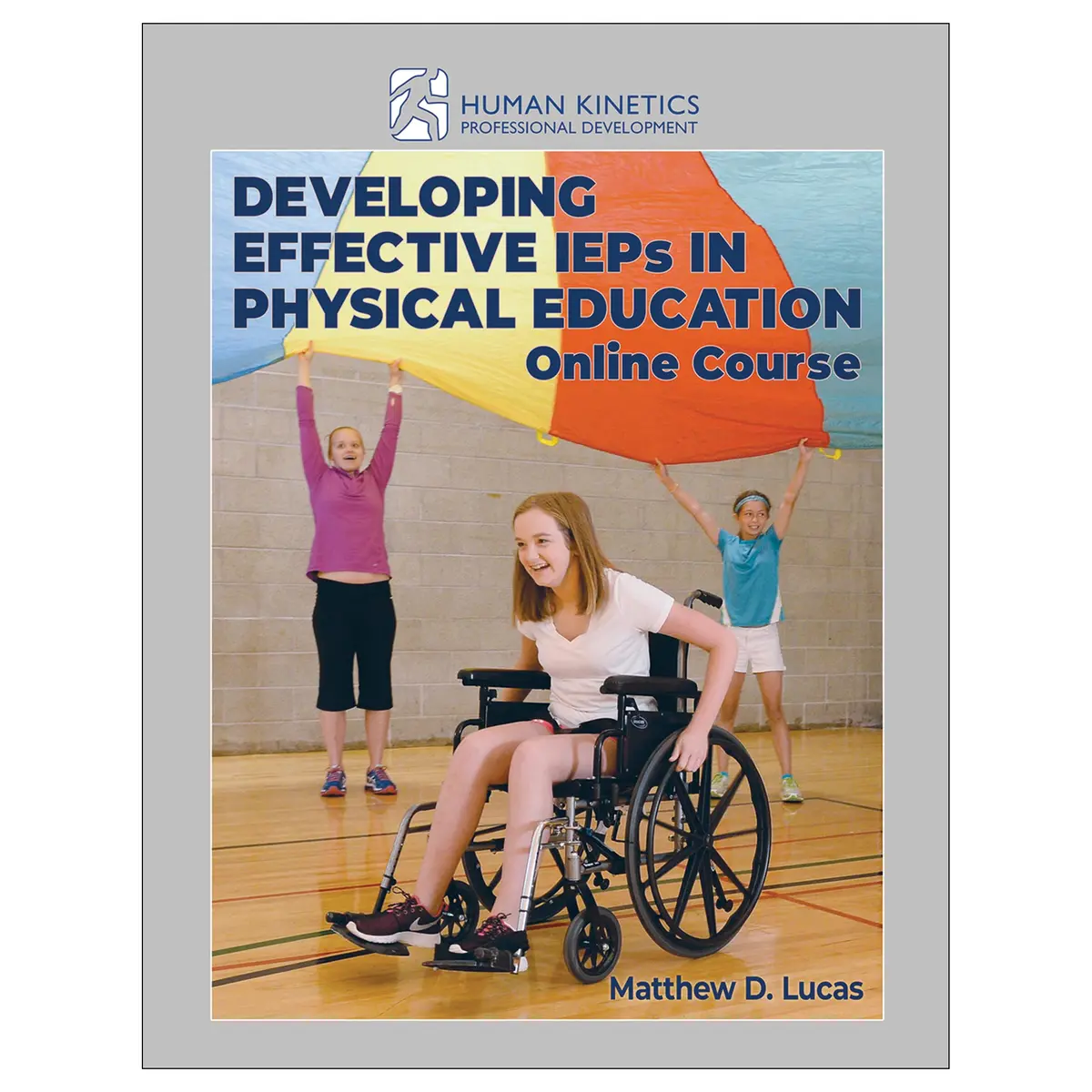
Description
- Description
- Table of Contents
- Author
Four issues gave rise to the creation of Developing Effective IEPs in Physical Education Online Course:
- All too often, IEPs (individualized education programs) do not specifically address physical education.
- Adapted physical education often is not included in the IEP process.
- Many physical educators are not prepared to contribute to the development of an effective IEP.
- Many physical educators fail to understand the legal ramifications of IEPs.
The result? Many students are being deprived of the top-quality physical education experience that they deserve.
Now, adapted physical educators, general physical educators, special education teachers, and others can use this highly practical course to create IEPs that are appropriate and effective for their students.
Developing Effective IEPs in Physical Education Online Course walks readers through a wealth of information in a concise, easy-to-understand way that facilitates effective collaboration on and implementation of individualized education programs. Accompanying video clips and practical examples enhance the learning. The course provides critical information and guidance on these topics:
- Special education laws
- Civil rights laws as they apply to students with disabilities
- IEP goals for the physical education of children whose disabilities affect their learning in the subject
The course also covers how to do the following:
- Assess children who need IEPs
- Determine student placement for physical education
- Enhance parental understanding of adapted physical education in the IEP process
- Understand the roles of administrators and physical educators in IEPs
- Ensure that the guarantees provided by the American with Disabilities Act are followed for children with disabilities in physical education
- Develop an IEP for adapted physical education, including writing a proper narrative and creating appropriate goals
Developing Effective IEPs in Physical Education Online Course, which is organized into five modules, will help physical education teachers be effectively involved in their students’ IEPs. Administrators can use the course as an excellent tool for providing professional development for their staff. Teachers can take the course individually on their own schedule, or a district administrator might want to have the district’s teachers take the course as a group and learn and discuss the material together.
Teachers can take an exam at the end of the course, leading to a certificate of completion, which can be presented to an administrator to gain professional development credit. The course represents three contact hours.
Developing Effective IEPs in Physical Education Online Course is ideal as a professional development course or as a supplemental resource for higher education adapted physical education courses or for methods, organization, or administration courses.
Audience
Professional development resource (3 contact hours) for adapted physical educators, general physical educators, special education teachers, classroom teachers, and K-12 school district administrators. Supplemental resource for higher education PETE and APE courses. Module 1. Special Education Law
Module 2. Adapted Physical Education
Module 3. Developing IEPs for APE
Module 4. Steps to Enhance Parental Understanding of APE in the IEP Process
Module 5. The Rights of Students and Parents
Matthew D. Lucas, EdD, is a professor of physical and health education at Longwood University in Farmville, Virginia. He received his EdD in adapted physical education from the University of Virginia in 2007. Dr. Lucas has taught since 1995 at different levels including elementary school, middle school, and the university level. Dr. Lucas runs three free sports and recreation programs that he created for children with disabilities in the Farmville area. Dr. Lucas also serves on the editorial boards of the adapted physical education journal Palaestra and the physical education journals Journal of Physical Education, Recreation, and Dance, Strategies, and The Virginia Journal. In addition he serves on the editorial board of the special education journals Journal of the American Academy of Special Education Professionals, and Special Education Research, Policy and Practice.
Explore more from our collection.
Reviews
There are no reviews yet.