Description
overviewfb55cd020f0643f08418183279e63a5f
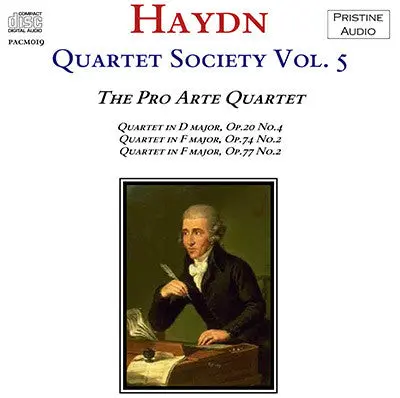
HAYDN String Quartet in D major, Op.20 No.4, Hob.III:34 “Sun”
HAYDN Quartet in F major, Op.74 No.2, Hob.III:73 “Apponyi”
HAYDN Quartet in F major, Op. 77 No.2, Hob.III:82 “Lobkowitz”
Recorded Abbey Road Studio 3, London. Recorded in 1935
Duration 59:57
The Pro Arte Quartet
578a9379d1e540bd96d26f03a79628d9review_titlefb55cd020f0643f08418183279e63a5fBill Rosen’s Review578a9379d1e540bd96d26f03a79628d9review_quotefb55cd020f0643f08418183279e63a5f The music never disappoints; the variety is beyond compare. How did one man conceive of such a body of work?578a9379d1e540bd96d26f03a79628d9review_bodyfb55cd020f0643f08418183279e63a5f
It seems to me that the reprocessing and sonic enhancement of the 78’s comprising this series grows finer with each volume: the sound is richer and aerier and there is greater presence and sense of staging. The music never disappoints; the variety is beyond compare. How did one man conceive of such a body of work?
Op. 20 #4 from the great “Sun” quartet series begins with a mellow theme which dominates the entire movement. A nearly textbook example of the “false recapitulation” ensues. A slow movement featuring variations is followed by a short minuet. The quartet is capped off by a mercurial finale in sonata form containing numerous themes with many starts and stops in Haydn’s typical witty mode.
Op. 74 #2 begins with a fanfare theme which is subject to considerable contrapuntal development, but which is allowed to recapitulate nearly normally (or as normal as Haydn ever gets). A slow movement with beautiful but rather conventional variations is followed by a vigorous minuet and a beautifully contrasted trio. The finale is a hell-for-leather prestissimo which never slackens but does permit a short development to zip by.
Op. 77 #2, Haydn’s last completed quartet, begins with a full, rich first movement whose themes are subject to a long development and a regular recapitulation. An agitated yet playful minuet encloses a suave trio. A noble andante is subject to variations which never really stray far from the theme. How Haydn does this while still maintaining interest is a secret known only to him. Haydn’s last quartet finale is one of the most thoroughly developed movements in classical quartet literature, a fitting end to one of music’s most inexhaustible treasures.
578a9379d1e540bd96d26f03a79628d9main_samplefb55cd020f0643f08418183279e63a5fsamples/PACM019.mp3578a9379d1e540bd96d26f03a79628d9tab1_labelfb55cd020f0643f08418183279e63a5fProducer’s Note578a9379d1e540bd96d26f03a79628d9tab1_typefb55cd020f0643f08418183279e63a5fcontent578a9379d1e540bd96d26f03a79628d9tab1_contentfb55cd020f0643f08418183279e63a5f
Fifth Volume of The Haydn Quartet Society
The Pro Arte Quartet, remastered for finest sound quality
To state that Haydn, more than perhaps any other composer, is responsible for the String Quartet as we know it – and from there the many other instrumental variations of chamber music of the Classical, Romantic and Modern periods – seems a very bold and sweeping comment. And yet it was Haydn who freed his quartets from the tyranny of the continuo and allowed his parts to move freely, without relying on the ‘gravity’ of a bass. It was Haydn who more or less invented Sonata form, and who developed the beautiful part-writing, following on from his own studies into earlier vocal polyphony, which is the essence of the string quartet medium.
Of his many quartets – one website lists 78 works for String Quartet by or attributed to Haydn – the Pro Arte Quartet chose 29 works to record in their ground-breaking 8-volume Haydn Quartet Society series, made for HMV between 1931 and 1938. These cover the full range of his output, from Op. 1 No. 1 (1762) to the two Opus 77 quartets of 1799 (the final Op. 103 remained unfinished).
Andrew Rose
578a9379d1e540bd96d26f03a79628d9tab1_cover_thumbnail1_s3_locationfb55cd020f0643f08418183279e63a5f578a9379d1e540bd96d26f03a79628d9tab1_cover_thumbnail2_s3_locationfb55cd020f0643f08418183279e63a5f578a9379d1e540bd96d26f03a79628d9tab1_cover_download_s3_locationfb55cd020f0643f08418183279e63a5f578a9379d1e540bd96d26f03a79628d9tab1_sample1_s3_locationfb55cd020f0643f08418183279e63a5f578a9379d1e540bd96d26f03a79628d9tab1_sample2_s3_locationfb55cd020f0643f08418183279e63a5f578a9379d1e540bd96d26f03a79628d9tab1_sample3_s3_locationfb55cd020f0643f08418183279e63a5f578a9379d1e540bd96d26f03a79628d9tab1_sample4_s3_locationfb55cd020f0643f08418183279e63a5f578a9379d1e540bd96d26f03a79628d9tab1_sample5_s3_locationfb55cd020f0643f08418183279e63a5f578a9379d1e540bd96d26f03a79628d9tab1_sample6_s3_locationfb55cd020f0643f08418183279e63a5f578a9379d1e540bd96d26f03a79628d9tab2_labelfb55cd020f0643f08418183279e63a5fFull Track Listing578a9379d1e540bd96d26f03a79628d9tab2_typefb55cd020f0643f08418183279e63a5ftrack_listing578a9379d1e540bd96d26f03a79628d9tab2_contentfb55cd020f0643f08418183279e63a5f
-
HAYDN String Quartet in D major, Op.20 No.4, Hob.III:34 “Sun”
-
HAYDN Quartet in F major, Op.74 No.2, Hob.III:73 “Apponyi”
-
HAYDN Quartet in F major, Op. 77 No.2, Hob.III:82 “Lobkowitz”
Recorded Abbey Road Studio 3, London
Recorded in 1935 and originally released as HMV DB2774-2780
Matrix Numbers: 2EA2539-I, 2EA2540-I, 2EA2514-I, 2EA2542-I, 2EA2543-II, 2EA2544-I, 2EA2545-I, 2EA2546-I, 2EA1312-II, 2EA1313-II, 2EA1314-II, 2EA1315-II, 2EA1316-II, 2EA1317-III.
Duration 59:57
The Pro Arte Quartet:
Alphonse Onnou, violin
Laurent Halleux, violin
Germain Prevost, viola
Robert Maas, cello
578a9379d1e540bd96d26f03a79628d9tab2_cover_thumbnail1_s3_locationfb55cd020f0643f08418183279e63a5f578a9379d1e540bd96d26f03a79628d9tab2_cover_thumbnail2_s3_locationfb55cd020f0643f08418183279e63a5f578a9379d1e540bd96d26f03a79628d9tab2_cover_download_s3_locationfb55cd020f0643f08418183279e63a5f578a9379d1e540bd96d26f03a79628d9tab2_sample1_s3_locationfb55cd020f0643f08418183279e63a5f578a9379d1e540bd96d26f03a79628d9tab2_sample2_s3_locationfb55cd020f0643f08418183279e63a5f578a9379d1e540bd96d26f03a79628d9tab2_sample3_s3_locationfb55cd020f0643f08418183279e63a5f578a9379d1e540bd96d26f03a79628d9tab2_sample4_s3_locationfb55cd020f0643f08418183279e63a5f578a9379d1e540bd96d26f03a79628d9tab2_sample5_s3_locationfb55cd020f0643f08418183279e63a5f578a9379d1e540bd96d26f03a79628d9tab2_sample6_s3_locationfb55cd020f0643f08418183279e63a5f578a9379d1e540bd96d26f03a79628d9tab3_labelfb55cd020f0643f08418183279e63a5fCover Art578a9379d1e540bd96d26f03a79628d9tab3_typefb55cd020f0643f08418183279e63a5fcover_art578a9379d1e540bd96d26f03a79628d9tab3_contentfb55cd020f0643f08418183279e63a5f578a9379d1e540bd96d26f03a79628d9tab3_cover_thumbnail1_s3_locationfb55cd020f0643f08418183279e63a5fcovers/thumbs/PACM019.jpg578a9379d1e540bd96d26f03a79628d9tab3_cover_thumbnail2_s3_locationfb55cd020f0643f08418183279e63a5f578a9379d1e540bd96d26f03a79628d9tab3_cover_download_s3_locationfb55cd020f0643f08418183279e63a5fcovers/PACM019.pdf578a9379d1e540bd96d26f03a79628d9tab3_sample1_s3_locationfb55cd020f0643f08418183279e63a5f578a9379d1e540bd96d26f03a79628d9tab3_sample2_s3_locationfb55cd020f0643f08418183279e63a5f578a9379d1e540bd96d26f03a79628d9tab3_sample3_s3_locationfb55cd020f0643f08418183279e63a5f578a9379d1e540bd96d26f03a79628d9tab3_sample4_s3_locationfb55cd020f0643f08418183279e63a5f578a9379d1e540bd96d26f03a79628d9tab3_sample5_s3_locationfb55cd020f0643f08418183279e63a5f578a9379d1e540bd96d26f03a79628d9tab3_sample6_s3_locationfb55cd020f0643f08418183279e63a5f
Explore more from our collection.


Reviews
There are no reviews yet.