Description
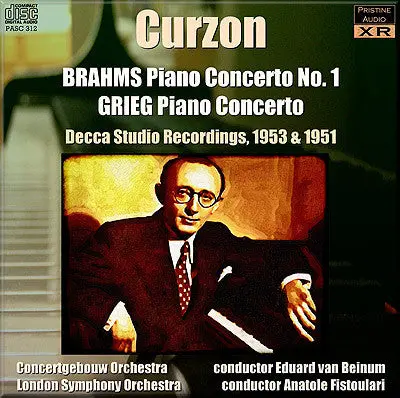
overviewfb55cd020f0643f08418183279e63a5fBRAHMS Piano Concerto No. 1
GRIEG Piano Concerto
Recorded in 1953 & 1951
Total duration: 77:45
Clifford Curzon, piano
Concertgebouw Orchestra
Eduard van Beinum, conductor
London Symphony Orchestra
Anatole Fistoulari, conductor578a9379d1e540bd96d26f03a79628d9review_titlefb55cd020f0643f08418183279e63a5fFanfare Review578a9379d1e540bd96d26f03a79628d9review_quotefb55cd020f0643f08418183279e63a5fIf he was capable of playing a routine bar I have yet to hear it.578a9379d1e540bd96d26f03a79628d9review_bodyfb55cd020f0643f08418183279e63a5f
The 1953 Brahms is the second of three studio recordings Clifford Curzon made for Decca, between the Enrique Jordá/National Symphony Orchestra (1945–46) and the George Szell/London Symphony Orchestra (1962). All are available in Decca’s gathering of his complete studio recordings in a series of bargain-priced Original Masters boxes. Although the difference in transfers is not huge, the advantage here goes to Pristine’s (from LPs, as usual), sounding richer, warmer, and with an expanded dynamic range compared to Decca’s own from the master tapes. If, in comparison to his stereo remake with Szell, the recording of the piano still comes across as rather colorless, lacking something in impact, that’s simply a limitation of the mono original.
Curzon was famous for completely rethinking his interpretations with every new performance or recorded remake of the same piece. Despite being very recognizably himself in fastidious nuance and refinement in all three versions, there are some very striking differences, most notably in the huge disparity of tempo in the Adagio, from a briskish 12 minutes with van Beinum to an incredibly spacious 16 (!) with Szell in 1962. On the other hand the finale got much slower between 1945 (though slackly conducted by Jordá) and 1953. Overall, the middle recording comes across as the most classical of the three, which has much to do with van Beinum’s conducting—lean-textured and buoyant, with finely drawn lines sharply projected by the Concertgebouw’s nasal, cutting sound, in striking contrast to Szell’s weighty, monumental approach with the richer-textured LSO. If much of the piano writing (starting from the first solo entry, which can come over as rather gray at the best of times) is inevitably more effectively projected in the better-recorded stereo remake, there is still much to relish, whether the virtuoso fire and attack of the first-movement development, the spontaneous, forward-pressing rhapsody of the Adagio’s restless second theme, or the inimitably Curzonian blend of visceral emotional engagement and minutely considered nuance in the finale’s two cadenzas.
As Pristine’s Andrew Rose notes, the Grieg (1951) was never a sonic prize, the recording of the orchestra rather grainy and opaque. If the Original Masters transfer seems to have a little more body and hall acoustic, that is outweighed by its markedly flat pitch, which Rose has corrected to the recording’s great advantage. The obvious comparison here is to the stereo remake with Øivin Fjeldstad (1959), which found the LSO in much better form than it was for Fistoulari in 1951; the earlier recording also suffers from an excessively slow Adagio (Fistoulari’s 7:16 to Fjeldstad’s 6:07). As for Curzon, if he was capable of playing a routine bar I have yet to hear it. He can certainly thunder when required, but the performance is most memorable for its delicacy and finesse of voicing, with breathtaking dynamic control at the quiet end of the spectrum, refinement of pedaling, and his trademark combination of singing luminosity with rhythmic tautness.
Curzon aficionados will probably find it worth supplementing their Original Masters discs with these new transfers. More general collectors are probably better served by the pianist’s stereo remakes.
Boyd Pomeroy
This article originally appeared in Issue 35:5 (May/June 2012) of Fanfare Magazine.
578a9379d1e540bd96d26f03a79628d9main_samplefb55cd020f0643f08418183279e63a5fsamples/PASC312.mp3578a9379d1e540bd96d26f03a79628d9tab1_labelfb55cd020f0643f08418183279e63a5fProducer’s Note578a9379d1e540bd96d26f03a79628d9tab1_typefb55cd020f0643f08418183279e63a5fcontent578a9379d1e540bd96d26f03a79628d9tab1_contentfb55cd020f0643f08418183279e63a5f
Clifford Curzon’s excellent Brahms and Grieg Concertos
“Most memorable for its delicacy and finesse of voicing, with breathtaking dynamic control, and his trademark combination of singing luminosity with rhythmic tautness” – Fanfare
Despite the presence at both sessions which produced these recordings of Decca’s crack recording duo, producer John Culshaw and engineer Kenneth Wilkinson, there was a marked difference sonically in the results they achieved. Indeed, the earlier recording of the Grieg, made in London in 1951 – and still prepared as for a 78rpm release which didn’t happen (an additional Chopin fill-up side was also recorded but never issued) – sounds particularly dim and dusty. Reviving this recording has perhaps been the major achievement in this release, with 32-bit XR remastering injecting a sense of life and reality missing from the Decca LP.
By contrast, the 1953 Brahms is a different matter altogether, recorded with a clarity that surely makes it a model recording of its era. Both recordings have also benefitted audibly from the latest pitch stabilisation techniques, especially again the Grieg, where what would have been the third 78pm side (the final third of the first movement) was distinctly flat by comparison to the rest of the recording.
Andrew Rose
578a9379d1e540bd96d26f03a79628d9tab1_cover_thumbnail1_s3_locationfb55cd020f0643f08418183279e63a5f578a9379d1e540bd96d26f03a79628d9tab1_cover_thumbnail2_s3_locationfb55cd020f0643f08418183279e63a5f578a9379d1e540bd96d26f03a79628d9tab1_cover_download_s3_locationfb55cd020f0643f08418183279e63a5f578a9379d1e540bd96d26f03a79628d9tab1_sample1_s3_locationfb55cd020f0643f08418183279e63a5f578a9379d1e540bd96d26f03a79628d9tab1_sample2_s3_locationfb55cd020f0643f08418183279e63a5f578a9379d1e540bd96d26f03a79628d9tab1_sample3_s3_locationfb55cd020f0643f08418183279e63a5f578a9379d1e540bd96d26f03a79628d9tab1_sample4_s3_locationfb55cd020f0643f08418183279e63a5f578a9379d1e540bd96d26f03a79628d9tab1_sample5_s3_locationfb55cd020f0643f08418183279e63a5f578a9379d1e540bd96d26f03a79628d9tab1_sample6_s3_locationfb55cd020f0643f08418183279e63a5f578a9379d1e540bd96d26f03a79628d9tab2_labelfb55cd020f0643f08418183279e63a5fFull Track Listing578a9379d1e540bd96d26f03a79628d9tab2_typefb55cd020f0643f08418183279e63a5ftrack_listing578a9379d1e540bd96d26f03a79628d9tab2_contentfb55cd020f0643f08418183279e63a5f
Recorded 19 May-1 June 1953, Concertgebouw, Amsterdam
Transfer from Decca LTX 2825
Royal Concertgebouw Orchestra of Amsterdam
Eduard van Beinum conductor
Recorded 15-16 October 1951, Kingsway Hall, London
Transfer from Decca LTX 2657
London Symphony Orchestra
Anatole Fistoulari conductor
Clifford Curzon piano
578a9379d1e540bd96d26f03a79628d9tab2_cover_thumbnail1_s3_locationfb55cd020f0643f08418183279e63a5f578a9379d1e540bd96d26f03a79628d9tab2_cover_thumbnail2_s3_locationfb55cd020f0643f08418183279e63a5f578a9379d1e540bd96d26f03a79628d9tab2_cover_download_s3_locationfb55cd020f0643f08418183279e63a5f578a9379d1e540bd96d26f03a79628d9tab2_sample1_s3_locationfb55cd020f0643f08418183279e63a5f578a9379d1e540bd96d26f03a79628d9tab2_sample2_s3_locationfb55cd020f0643f08418183279e63a5f578a9379d1e540bd96d26f03a79628d9tab2_sample3_s3_locationfb55cd020f0643f08418183279e63a5f578a9379d1e540bd96d26f03a79628d9tab2_sample4_s3_locationfb55cd020f0643f08418183279e63a5f578a9379d1e540bd96d26f03a79628d9tab2_sample5_s3_locationfb55cd020f0643f08418183279e63a5f578a9379d1e540bd96d26f03a79628d9tab2_sample6_s3_locationfb55cd020f0643f08418183279e63a5f578a9379d1e540bd96d26f03a79628d9tab3_labelfb55cd020f0643f08418183279e63a5fCover Art578a9379d1e540bd96d26f03a79628d9tab3_typefb55cd020f0643f08418183279e63a5fcover_art578a9379d1e540bd96d26f03a79628d9tab3_contentfb55cd020f0643f08418183279e63a5f578a9379d1e540bd96d26f03a79628d9tab3_cover_thumbnail1_s3_locationfb55cd020f0643f08418183279e63a5fcovers/thumbs/PASC312.jpg578a9379d1e540bd96d26f03a79628d9tab3_cover_thumbnail2_s3_locationfb55cd020f0643f08418183279e63a5f578a9379d1e540bd96d26f03a79628d9tab3_cover_download_s3_locationfb55cd020f0643f08418183279e63a5fcovers/PASC312.pdf578a9379d1e540bd96d26f03a79628d9tab3_sample1_s3_locationfb55cd020f0643f08418183279e63a5f578a9379d1e540bd96d26f03a79628d9tab3_sample2_s3_locationfb55cd020f0643f08418183279e63a5f578a9379d1e540bd96d26f03a79628d9tab3_sample3_s3_locationfb55cd020f0643f08418183279e63a5f578a9379d1e540bd96d26f03a79628d9tab3_sample4_s3_locationfb55cd020f0643f08418183279e63a5f578a9379d1e540bd96d26f03a79628d9tab3_sample5_s3_locationfb55cd020f0643f08418183279e63a5f578a9379d1e540bd96d26f03a79628d9tab3_sample6_s3_locationfb55cd020f0643f08418183279e63a5f
Explore more from our collection.



Reviews
There are no reviews yet.