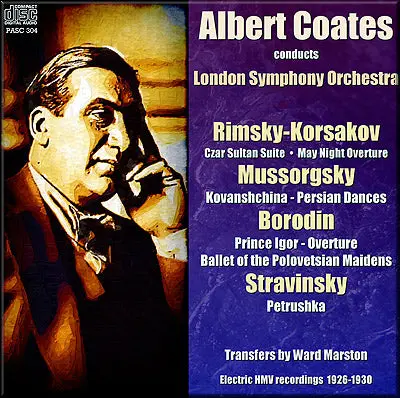
Description
overviewfb55cd020f0643f08418183279e63a5fSTRAVINSKY Petrushka Ballet
BORODIN Prince Igor – excerpts
RIMSKY-KORSAKOV Czar Sultan – Suite
RIMSKY-KORSAKOV May Night – Overture
MUSSORGSKY Khovanshchina: Persian Dances
Electric HMV recordings 1926-30
Total duration: 73:15
Albert Coates, conductor
London Symphony Orchestra
578a9379d1e540bd96d26f03a79628d9review_titlefb55cd020f0643f08418183279e63a5fGramophone Historic Review578a9379d1e540bd96d26f03a79628d9review_quotefb55cd020f0643f08418183279e63a5fHmm! Stravinsky! Now we’re in for something weird!578a9379d1e540bd96d26f03a79628d9review_bodyfb55cd020f0643f08418183279e63a5f
Petrushka (1930):
“…Of Stravinsky on her programme, ” Hmm ! Stravinsky ! Now we’re in for something weird ! ” What we actually were in for was the Berceuse and Finale of The Fire Bird, which, had the printer of the programme erroneously attributed to the pen of Rimsky-Korsakov, the good lady would assuredly have applauded as vehemently as she did Scheherazacle at the same concert. So much for the average Briton’s attitude towards musical progress. Yet why should early Stravinsky still be imagined by so many to be so revolutionary and incomprehensible 7 The Fire Bird was written in 1910— surely nineteen years is sufficient time even for an average British concert-goer to assimilate its idiom. The answer must lie in the fact that ever since Petrouchka Stravinsky has been such an experimentalist, and his idiom has been so elusive, that his reputation is better known than his music, and so our conservative concert-goers get afraid, and refuse to become conversant with any form of music later than Wagner. To these I would say : “Ladies and Gentlemen, go to your gramophone dealer and listen to a few records of contemporary music ; it will cost you nothing, and you will gain the knowledge that there is nothing at all offensive in such works as The Fire Bird, nothing in fact that is incompatible with the traditions of Rimsky-Korsakov, Borodin and others ; then you will go to the concert hall and hear with unprejudiced ears the same works, and will enjoy them.”
…
In 1911 appeared Petrouchka, which is still regarded by many as Stravinsky’s masterpiece, though none can maintain that he ceased developing at this date. Certainly his later works are more abstruse and objective, but Stravinsky never stands still, he always moves forward, forward, forward, and even though his followers may sometimes be led into somewhat cacophonic by-roads, the discursions are always interesting, and open up new paths of development. Nevertheless Petrouchka is certainly the apex of his genius in multi-coloured orchestral resourcefulness, and it is probably the most musically influential of all his works ; hardly one of the younger generation of Russian Ballet composers has escaped the influence of Petrouchka in some form or another, and probably that is why it is the best known of his works. Stravinsky, as I have said before, changes his style so often that it is almost impossible to say which is the most representative of his works, yet to a grarnophile who knows nothing of this amazing composer’s works I would recommend Petrouchka as his first introduction to Stravinsky. Two excellent sets of Petrouchka records are available ; one on six sides of Columbia (L2173-5), conducted by the composer, and the other on eight sides of H.M.V. (D1521-4) by the London Symphony Orchestra under Albert Coates. Both renderings are extremely – good the Columbia version is the noisier, yet I think on the whole the clearer and more supple, but I greatly regret the excision of the trumpet, flute and bassoon trio where the Moor makes love to the ballerina. I personally chose the H.M.V. version for its completeness.”
“These Moderns 1.—Russia: Stravinsky and Prokofiev” (excerpts) by A. M. Gordon-Brown, The Gramophone, March 1930
578a9379d1e540bd96d26f03a79628d9main_samplefb55cd020f0643f08418183279e63a5fsamples/PASC304.mp3578a9379d1e540bd96d26f03a79628d9tab1_labelfb55cd020f0643f08418183279e63a5fFull Track Listing578a9379d1e540bd96d26f03a79628d9tab1_typefb55cd020f0643f08418183279e63a5ftrack_listing578a9379d1e540bd96d26f03a79628d9tab1_contentfb55cd020f0643f08418183279e63a5f
Recorded 16 February 1928. matrices CR-1699-1A and CR-1700-1;
HMV D1491.
Matrix CR-2454-3, Recorded 8 October 1929, Queen’s Hall, transmitted by phone line to Small Queen’s Hall; matrix Cc-17848-2, recorded 5 November 1929, Hayes Main Studio.
Issued on HMV D1744.
Recorded 7 May 1930, Queen’s Hall, transmitted by phone line to Small Queen’s Hall.
Matrices CR-2486-2 and CR-2487-2; Issued on HMV D1855.
Recorded 26 October 1926, Kingsway Hall, transmitted by phone line to Small Qqueen’s Hall.
Matrices CR-815-1 and CR-816-1;Issued on HMV D1210.
Recorded 24 October 1927, Queen’s Hall, transmitted by phone line to Small Queen’s Hall; matrices CR-1554-1 and CR-1555-1A; Issued on HMV D1528.
Recorded 19 and 24 October 1927, Queen’s Hall, transmitted by phone line to Small Queen’s Hall;; 5 January and 15 February 1928. Kingsway Hall; transmitted by phone line to Small Queen’s Hall.
Issued on HMV D1521-1524.
This set was also issued on Italian and Czech HMV as well as Electrola but never on Victor.
The matrix and date information is as follows:
Side 1. CR-1542-2B (19 October 1927)
Side 2. CR-1543-3A (5 January 1928)
Side 3. CR-1544-1A (19 October 1927)
Side 4. CR-1545-4 (15 February 1928)
Side 5. CR-1546-1A (19 October 1927)
Side 6. CR-1547-2 (15 February 1928)
Side 7. CR-1552-1A (24 October 1927)
Side 8. CR-1553-2 (24 October 1927)
The present transfer was made from mid-1930s Electrola pressings, EJ381-384.
London Symphony Orchestra
Albert Coates, conductor
Electric HMV recordings 1926-30
Transfers by Ward Marston
Cover artwork based on a photograph of Albert Coates
Total duration: 73:15
578a9379d1e540bd96d26f03a79628d9tab1_cover_thumbnail1_s3_locationfb55cd020f0643f08418183279e63a5f578a9379d1e540bd96d26f03a79628d9tab1_cover_thumbnail2_s3_locationfb55cd020f0643f08418183279e63a5f578a9379d1e540bd96d26f03a79628d9tab1_cover_download_s3_locationfb55cd020f0643f08418183279e63a5f578a9379d1e540bd96d26f03a79628d9tab1_sample1_s3_locationfb55cd020f0643f08418183279e63a5f578a9379d1e540bd96d26f03a79628d9tab1_sample2_s3_locationfb55cd020f0643f08418183279e63a5f578a9379d1e540bd96d26f03a79628d9tab1_sample3_s3_locationfb55cd020f0643f08418183279e63a5f578a9379d1e540bd96d26f03a79628d9tab1_sample4_s3_locationfb55cd020f0643f08418183279e63a5f578a9379d1e540bd96d26f03a79628d9tab1_sample5_s3_locationfb55cd020f0643f08418183279e63a5f578a9379d1e540bd96d26f03a79628d9tab1_sample6_s3_locationfb55cd020f0643f08418183279e63a5f578a9379d1e540bd96d26f03a79628d9tab2_labelfb55cd020f0643f08418183279e63a5fCover Art578a9379d1e540bd96d26f03a79628d9tab2_typefb55cd020f0643f08418183279e63a5fcover_art578a9379d1e540bd96d26f03a79628d9tab2_contentfb55cd020f0643f08418183279e63a5f578a9379d1e540bd96d26f03a79628d9tab2_cover_thumbnail1_s3_locationfb55cd020f0643f08418183279e63a5fcovers/thumbs/PASC304.jpg578a9379d1e540bd96d26f03a79628d9tab2_cover_thumbnail2_s3_locationfb55cd020f0643f08418183279e63a5f578a9379d1e540bd96d26f03a79628d9tab2_cover_download_s3_locationfb55cd020f0643f08418183279e63a5fcovers/PASC304.pdf578a9379d1e540bd96d26f03a79628d9tab2_sample1_s3_locationfb55cd020f0643f08418183279e63a5f578a9379d1e540bd96d26f03a79628d9tab2_sample2_s3_locationfb55cd020f0643f08418183279e63a5f578a9379d1e540bd96d26f03a79628d9tab2_sample3_s3_locationfb55cd020f0643f08418183279e63a5f578a9379d1e540bd96d26f03a79628d9tab2_sample4_s3_locationfb55cd020f0643f08418183279e63a5f578a9379d1e540bd96d26f03a79628d9tab2_sample5_s3_locationfb55cd020f0643f08418183279e63a5f578a9379d1e540bd96d26f03a79628d9tab2_sample6_s3_locationfb55cd020f0643f08418183279e63a5f
Explore more from our collection.
Reviews
There are no reviews yet.