Description
overviewfb55cd020f0643f08418183279e63a5f
BRAHMS Piano Quartet No. 1
BRAHMS String Sextet No. 1
Live concert recordings, 1949
Total duration: 70:36
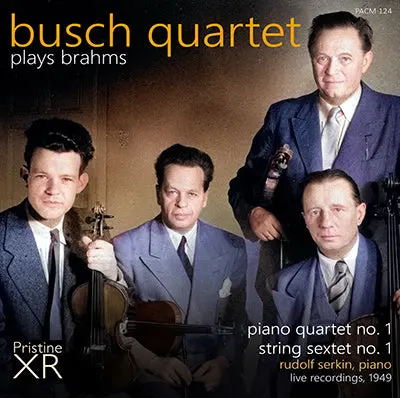
Busch Quartet
Adolf Busch, Bruno Straumann, violins
Hugo Gottesmann, viola
Herman Busch, cello
with Rudolf Serkin, piano
Albert Bertschmann, viola
August Wenzinger, cello
578a9379d1e540bd96d26f03a79628d9review_titlefb55cd020f0643f08418183279e63a5f578a9379d1e540bd96d26f03a79628d9review_quotefb55cd020f0643f08418183279e63a5f578a9379d1e540bd96d26f03a79628d9review_bodyfb55cd020f0643f08418183279e63a5f578a9379d1e540bd96d26f03a79628d9main_samplefb55cd020f0643f08418183279e63a5fsamples/PACM124.mp3578a9379d1e540bd96d26f03a79628d9tab1_labelfb55cd020f0643f08418183279e63a5fProducer’s Note578a9379d1e540bd96d26f03a79628d9tab1_typefb55cd020f0643f08418183279e63a5fcontent578a9379d1e540bd96d26f03a79628d9tab1_contentfb55cd020f0643f08418183279e63a5f
The Strasbourg Music Festival was founded in 1932, the same year Adolf Busch first appeared in a Strasbourg Busch Quartet concert featuring music by Mozart, Haydn, and Beethoven. After Adolf Busch returned to Europe in 1947, one of his engagements included three concerts in Strasbourg for the 11th Strasbourg Music Festival, subtitled “Festival de Musique Romantique,” held from 9 to 21 June, 1949. The festival presented fourteen concerts, showcasing a wide array of music, including soirées featuring Lieder and piano music by Schubert, Schumann, and Brahms respectively, orchestral performances (notably Brahms’s Double Concerto with Adolf and Herman Busch conducted by Paul Kletzki), choral orchestral music, and two chamber music concerts by the Busch Quartet with additional performers. Only parts of these two concerts have survived on record, including the two Brahms works featured here. Both pieces, performed in the Salle de l’Aubette, were regularly played by the Busch Quartet, though the 1949 performance of the Sextet is the only known recording of the Buschs’ interpretation.
The BBC had inquired about taping the 11 June concert and broadcasting it on the World Service later that year. However, Rudolf Serkin was hesitant because the Piano Quartet in G minor, Op. 25, had been recorded just a fortnight earlier, on 25-26 May, 1949, at the London Abbey Road Studios. Consequently, the Strasbourg performance remained little-known until its release in 1981 on a short-lived, obscure LP label.
A concert review in the Journal d’Alsace et de Lorraine praised the collaboration: “The Serkin-Busch conjunction, long-standing, obviously relates to pre-established harmony. What we praise about the Buschs, we can transpose onto Serkin, and whether their musical relationship predates their association, or is the fruit of long collaboration, or both, I don’t know; this is what makes the quality of their ensemble. Serkin is a pianist of exceptional quality, which is good; but what is better and rarer is a chamber music pianist. […] The integration of the pianist into the ensemble is perfect, both meticulously thought out and organically experienced. The fact is rare enough to require emphasis.” Similarly, the Dernières Nouvelles d’Alsace remarked: “The quartet was played with so much joy that one would have said the author himself was dictating it to his confidants. […] The Buschs penetrated it, enriching it with a thousand nuances.”
The Bb major Sextet had been specially requested by the festival’s founder, renowned dermatologist Lucien-Marie Pautrier. The Busch Quartet was joined by Albert Bertschmann, principal viola of the Basel Orchester-Gesellschaft, and August Wenzinger, a Basel-based cellist and pioneer of historically informed performance practice, who had studied under Paul Grümmer, the former cellist of the Busch Quartet. One newspaper review noted: “It is important to these artists to captivate the listener through the liveliness of the execution, bringing the work as close to him as possible. The fact that they succeed in this, as rarely does any other quartet, is evident from the applause and ovations that the packed hall gave the artists; and this after Brahms’ Sextet, a work that, despite its beauties, is not easily accessible to the listener.”
Busch greatly enjoyed his return to Strasbourg and immediately agreed to more concerts. The Busch Quartet returned for a programme of Haydn, Brahms, and Beethoven in January 1951.
Dr. Jürgen Schaarwächter – BuschBrothersArchive in the Max-Reger-Institut, Karlsruhe
578a9379d1e540bd96d26f03a79628d9tab1_cover_thumbnail1_s3_locationfb55cd020f0643f08418183279e63a5f578a9379d1e540bd96d26f03a79628d9tab1_cover_thumbnail2_s3_locationfb55cd020f0643f08418183279e63a5f578a9379d1e540bd96d26f03a79628d9tab1_cover_download_s3_locationfb55cd020f0643f08418183279e63a5f578a9379d1e540bd96d26f03a79628d9tab1_sample1_s3_locationfb55cd020f0643f08418183279e63a5f578a9379d1e540bd96d26f03a79628d9tab1_sample2_s3_locationfb55cd020f0643f08418183279e63a5f578a9379d1e540bd96d26f03a79628d9tab1_sample3_s3_locationfb55cd020f0643f08418183279e63a5f578a9379d1e540bd96d26f03a79628d9tab1_sample4_s3_locationfb55cd020f0643f08418183279e63a5f578a9379d1e540bd96d26f03a79628d9tab1_sample5_s3_locationfb55cd020f0643f08418183279e63a5f578a9379d1e540bd96d26f03a79628d9tab1_sample6_s3_locationfb55cd020f0643f08418183279e63a5f578a9379d1e540bd96d26f03a79628d9tab2_labelfb55cd020f0643f08418183279e63a5fFull Track Listing578a9379d1e540bd96d26f03a79628d9tab2_typefb55cd020f0643f08418183279e63a5ftrack_listing578a9379d1e540bd96d26f03a79628d9tab2_contentfb55cd020f0643f08418183279e63a5f
BUSCH QUARTET plays Brahms
BRAHMS Piano Quartet No. 1 in G minor, Op. 25
1. 1st mvt. – Allegro (12:37)
2. 2nd mvt. – Intermezzo. Allegro ma non troppo – Trio. Animato (8:22)
3. 3rd mvt. – Andante con moto (9:41)
4. 4th mvt. – Rondo all Zingarese. Presto (8:21)
Concert performance of 11 June, 1949
BRAHMS String Sextet No. 1 in B-flat major, Op. 18
5. 1st mvt. – Allegro ma non troppo (10:01)
6. 2nd mvt. – Andante ma moderato (9:30)
7. 3rd mvt. – Scherzo. Allegro molto (2:44)
8. 4th mvt. – Rondo. Poco Allegretto e grazioso (9:20)
Concert performance of 13 June, 1949
Busch Quartet
Adolf Busch, Bruno Straumann, violins
Hugo Gottesmann, viola
Herman Busch, cello
with Rudolf Serkin, piano
Albert Bertschmann, viola
August Wenzinger, cello
XR remastered in Ambient Stereo by Andrew Rose
NB. These performances were captured on delicate acetate 78rpm discs. Some sound deterioration can be heard throughout the two recordings.
Recorded at Festival de Musique Romantique: Société des amis de la musique Strasbourg
Cover artwork based on a photograph of the Busch Quartet
Special thanks to Dr. Jürgen Schaarwächter and Tully Potter
Produced in co-operation with the Max-Reger-Institut/BuschBrothersArchive, Karlsruhe, Germany
Total duration: 70:36
578a9379d1e540bd96d26f03a79628d9tab2_cover_thumbnail1_s3_locationfb55cd020f0643f08418183279e63a5f578a9379d1e540bd96d26f03a79628d9tab2_cover_thumbnail2_s3_locationfb55cd020f0643f08418183279e63a5f578a9379d1e540bd96d26f03a79628d9tab2_cover_download_s3_locationfb55cd020f0643f08418183279e63a5f578a9379d1e540bd96d26f03a79628d9tab2_sample1_s3_locationfb55cd020f0643f08418183279e63a5f578a9379d1e540bd96d26f03a79628d9tab2_sample2_s3_locationfb55cd020f0643f08418183279e63a5f578a9379d1e540bd96d26f03a79628d9tab2_sample3_s3_locationfb55cd020f0643f08418183279e63a5f578a9379d1e540bd96d26f03a79628d9tab2_sample4_s3_locationfb55cd020f0643f08418183279e63a5f578a9379d1e540bd96d26f03a79628d9tab2_sample5_s3_locationfb55cd020f0643f08418183279e63a5f578a9379d1e540bd96d26f03a79628d9tab2_sample6_s3_locationfb55cd020f0643f08418183279e63a5f578a9379d1e540bd96d26f03a79628d9tab3_labelfb55cd020f0643f08418183279e63a5fCover Art578a9379d1e540bd96d26f03a79628d9tab3_typefb55cd020f0643f08418183279e63a5fcover_art578a9379d1e540bd96d26f03a79628d9tab3_contentfb55cd020f0643f08418183279e63a5f578a9379d1e540bd96d26f03a79628d9tab3_cover_thumbnail1_s3_locationfb55cd020f0643f08418183279e63a5fcovers/thumbs/PACM124.jpg578a9379d1e540bd96d26f03a79628d9tab3_cover_thumbnail2_s3_locationfb55cd020f0643f08418183279e63a5f578a9379d1e540bd96d26f03a79628d9tab3_cover_download_s3_locationfb55cd020f0643f08418183279e63a5fcovers/PACM124.pdf578a9379d1e540bd96d26f03a79628d9tab3_sample1_s3_locationfb55cd020f0643f08418183279e63a5f578a9379d1e540bd96d26f03a79628d9tab3_sample2_s3_locationfb55cd020f0643f08418183279e63a5f578a9379d1e540bd96d26f03a79628d9tab3_sample3_s3_locationfb55cd020f0643f08418183279e63a5f578a9379d1e540bd96d26f03a79628d9tab3_sample4_s3_locationfb55cd020f0643f08418183279e63a5f578a9379d1e540bd96d26f03a79628d9tab3_sample5_s3_locationfb55cd020f0643f08418183279e63a5f578a9379d1e540bd96d26f03a79628d9tab3_sample6_s3_locationfb55cd020f0643f08418183279e63a5f
Explore more from our collection.



Reviews
There are no reviews yet.