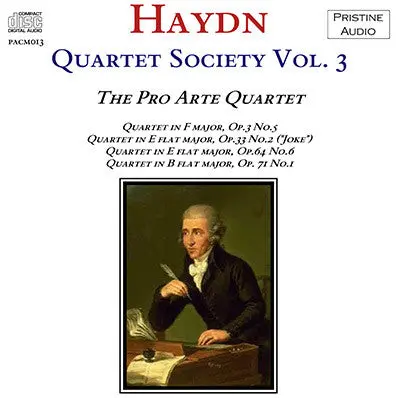
Description
overviewfb55cd020f0643f08418183279e63a5f
HAYDN String Quartet Op. 3, No. 5 in F major, Hob.III:17
HAYDN String Quartet Op. 33, No. 2 in E♭ major, Hob.III:38 “The Joke”
HAYDN String Quartet Op. 64, No. 6 in E♭ major, Hob.III:64
HAYDN String Quartet Op. 71, No. 1 in C minor, Hob.III:69 “Apponyi”
Recorded Abbey Road Studio 3, London. Recorded in 1933
(Duration 59’25”)
The Pro Arte Quartet
578a9379d1e540bd96d26f03a79628d9review_titlefb55cd020f0643f08418183279e63a5fBill Rosen’s Review578a9379d1e540bd96d26f03a79628d9review_quotefb55cd020f0643f08418183279e63a5fThere is something about the Pro Arte that sets forces in motion in me…578a9379d1e540bd96d26f03a79628d9review_bodyfb55cd020f0643f08418183279e63a5f
There is something about the Pro Arte performances and their life-giving enhancements by Pristine Audio that has provided me a much greater insight at the age of 73 into the unfathomable depths of the world of Haydn’s quartets. They are different in kind from Mozart and Beethoven and Schubert and I despair from ever summing them up. The best I can do is to say is that they are “genius at cosmic play”. They are, of course, well served by the modern quartets–the Mosaiques and the Juilliard, in particular–but there is something about the Pro Arte that sets forces in motion in me.
Op. 3 #5 is not by Haydn but by Roman Hoffstetter, who, if he is not Haydn, should be. A perky, irrepressible allegro leads to the famous serenade, which the Pro Arte plays very straight. A forceful minuet then is followed by a nippy little theme which breaks out of its cage and does some big things, a typical Haydn trademark. Fess up, Roman, where did you get the manuscript?
Op. 33 #2 is a very inventive work that opens with a large, swinging theme. Strong contrapuntal and harmonic development lands us at one of Haydn’s favorite tricks: the False Recapitulation! A little more devopment and we get the real recapitulation which is filled with more development. A minuet with surprises and a waltz-like trio is followed by a serious hymnlike slow movement with fortissimo interjections. Finally, a real triumph, a jolly presto made from only one theme–one of Haydn monothematic finale marvels. What a work!
Op. 64 #6 features a mellow theme subjected to a strong contrapuntal development and then even worked over some more in the recapitulation. The second movement is a 3-part solemn adagio punctuated by a string caprice. An unsettled minuet is paired with a trio with very high harmonics. The finale has a skittish, nondescript theme which is always a signal in Haydn that all Hell will break loose and boy does it ever.
Finally, Op. 71 #1 begins with five chords announcing a looselimbed theme which goes through more adventures than Rambo. A very beautiful and harmonically advanced slow movement follows. A mellow, traditional minuet leads to a coruscating presto finale in sonata form. The development is so fast and serious that while I was looking for the recapulation, the movement and the quartet ended soft and quicksilver.
Bill Rosen
578a9379d1e540bd96d26f03a79628d9main_samplefb55cd020f0643f08418183279e63a5fsamples/PACM013.mp3578a9379d1e540bd96d26f03a79628d9tab1_labelfb55cd020f0643f08418183279e63a5fProducer’s Note578a9379d1e540bd96d26f03a79628d9tab1_typefb55cd020f0643f08418183279e63a5fcontent578a9379d1e540bd96d26f03a79628d9tab1_contentfb55cd020f0643f08418183279e63a5f
Third Volume of The Haydn Quartet Society
The Pro Arte Quartet, remastered for finest sound quality
To state that Haydn, more than perhaps any other composer, is responsible for the String Quartet as we know it – and from there the many other instrumental variations of chamber music of the Classical, Romantic and Modern periods – seems a very bold and sweeping comment. And yet it was Haydn who freed his quartets from the tyranny of the continuo and allowed his parts to move freely, without relying on the ‘gravity’ of a bass. It was Haydn who more or less invented Sonata form, and who developed the beautiful part-writing, following on from his own studies into earlier vocal polyphony, which is the essence of the string quartet medium.
Of his many quartets – one website lists 78 works for String Quartet by or attributed to Haydn – the Pro Arte Quartet chose 29 works to record in their ground-breaking 8-volume Haydn Quartet Society series, made for HMV between 1931 and 1938. These cover the full range of his output, from Op. 1 No. 1 (1762) to the two Opus 77 quartets of 1799 (the final Op. 103 remained unfinished).
Andrew Rose
578a9379d1e540bd96d26f03a79628d9tab1_cover_thumbnail1_s3_locationfb55cd020f0643f08418183279e63a5f578a9379d1e540bd96d26f03a79628d9tab1_cover_thumbnail2_s3_locationfb55cd020f0643f08418183279e63a5f578a9379d1e540bd96d26f03a79628d9tab1_cover_download_s3_locationfb55cd020f0643f08418183279e63a5f578a9379d1e540bd96d26f03a79628d9tab1_sample1_s3_locationfb55cd020f0643f08418183279e63a5f578a9379d1e540bd96d26f03a79628d9tab1_sample2_s3_locationfb55cd020f0643f08418183279e63a5f578a9379d1e540bd96d26f03a79628d9tab1_sample3_s3_locationfb55cd020f0643f08418183279e63a5f578a9379d1e540bd96d26f03a79628d9tab1_sample4_s3_locationfb55cd020f0643f08418183279e63a5f578a9379d1e540bd96d26f03a79628d9tab1_sample5_s3_locationfb55cd020f0643f08418183279e63a5f578a9379d1e540bd96d26f03a79628d9tab1_sample6_s3_locationfb55cd020f0643f08418183279e63a5f578a9379d1e540bd96d26f03a79628d9tab2_labelfb55cd020f0643f08418183279e63a5fFull Track Listing578a9379d1e540bd96d26f03a79628d9tab2_typefb55cd020f0643f08418183279e63a5ftrack_listing578a9379d1e540bd96d26f03a79628d9tab2_contentfb55cd020f0643f08418183279e63a5f
-
HAYDN String Quartet Op. 3, No. 5 in F major, Hob.III:17
-
HAYDN String Quartet Op. 33, No. 2 in E♭ major, Hob.III:38 “The Joke”
-
HAYDN String Quartet Op. 64, No. 6 in E♭ major, Hob.III:64
-
HAYDN String Quartet Op. 71, No. 1 in C minor, Hob.III:69 “Apponyi”
Recorded Abbey Road Studio 3, London
Recorded in 1933 and originally released as HMV DB12159-2165
Matrix Numbers: 2B5500-I, 2B5501-I, 2B5496-II, 2B5497-II, 2B5498-II, 2B5499-I, 2B5503-I, 2B5504-I, 2B5505-I, 2B5506-I, 2B5507-I, 2B5508-I, 2B5509-II, 2B5510-I
(Duration 59’25”)
The Pro Arte Quartet:
Alphonse Onnou, violin
Laurent Halleux, violin
Germain Prevost, viola
Robert Maas, cello
578a9379d1e540bd96d26f03a79628d9tab2_cover_thumbnail1_s3_locationfb55cd020f0643f08418183279e63a5f578a9379d1e540bd96d26f03a79628d9tab2_cover_thumbnail2_s3_locationfb55cd020f0643f08418183279e63a5f578a9379d1e540bd96d26f03a79628d9tab2_cover_download_s3_locationfb55cd020f0643f08418183279e63a5f578a9379d1e540bd96d26f03a79628d9tab2_sample1_s3_locationfb55cd020f0643f08418183279e63a5f578a9379d1e540bd96d26f03a79628d9tab2_sample2_s3_locationfb55cd020f0643f08418183279e63a5f578a9379d1e540bd96d26f03a79628d9tab2_sample3_s3_locationfb55cd020f0643f08418183279e63a5f578a9379d1e540bd96d26f03a79628d9tab2_sample4_s3_locationfb55cd020f0643f08418183279e63a5f578a9379d1e540bd96d26f03a79628d9tab2_sample5_s3_locationfb55cd020f0643f08418183279e63a5f578a9379d1e540bd96d26f03a79628d9tab2_sample6_s3_locationfb55cd020f0643f08418183279e63a5f578a9379d1e540bd96d26f03a79628d9tab3_labelfb55cd020f0643f08418183279e63a5fCover Art578a9379d1e540bd96d26f03a79628d9tab3_typefb55cd020f0643f08418183279e63a5fcover_art578a9379d1e540bd96d26f03a79628d9tab3_contentfb55cd020f0643f08418183279e63a5f578a9379d1e540bd96d26f03a79628d9tab3_cover_thumbnail1_s3_locationfb55cd020f0643f08418183279e63a5fcovers/thumbs/PACM013.jpg578a9379d1e540bd96d26f03a79628d9tab3_cover_thumbnail2_s3_locationfb55cd020f0643f08418183279e63a5f578a9379d1e540bd96d26f03a79628d9tab3_cover_download_s3_locationfb55cd020f0643f08418183279e63a5fcovers/PACM013.pdf578a9379d1e540bd96d26f03a79628d9tab3_sample1_s3_locationfb55cd020f0643f08418183279e63a5f578a9379d1e540bd96d26f03a79628d9tab3_sample2_s3_locationfb55cd020f0643f08418183279e63a5f578a9379d1e540bd96d26f03a79628d9tab3_sample3_s3_locationfb55cd020f0643f08418183279e63a5f578a9379d1e540bd96d26f03a79628d9tab3_sample4_s3_locationfb55cd020f0643f08418183279e63a5f578a9379d1e540bd96d26f03a79628d9tab3_sample5_s3_locationfb55cd020f0643f08418183279e63a5f578a9379d1e540bd96d26f03a79628d9tab3_sample6_s3_locationfb55cd020f0643f08418183279e63a5f
Explore more from our collection.
Reviews
There are no reviews yet.