Description
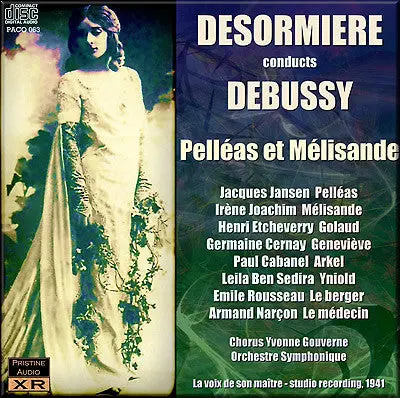
overviewfb55cd020f0643f08418183279e63a5fDEBUSSY Pelléas et Mélisande
Recorded in Paris in 1941
Total duration: 2hr 34:23
Irene Joachim
Jacques Jansen
Chorus Yvonne Gouverne
Orchestre Symphonique
Roger Désormière, conductor578a9379d1e540bd96d26f03a79628d9review_titlefb55cd020f0643f08418183279e63a5fFanfare Review578a9379d1e540bd96d26f03a79628d9review_quotefb55cd020f0643f08418183279e63a5fThe principals have voices that seem to float upon Debussy’s melodies578a9379d1e540bd96d26f03a79628d9review_bodyfb55cd020f0643f08418183279e63a5f
This much-reissued set has achieved classic status and, as a performance, per se, certainly deserves it. Unlike EMI and Andante, which coupled it with other historical recordings, Pristine gives you just this 1941 performance, recorded as German troops approached Paris. While you miss out on some interesting things, you only pay for two CDs that contain a truly first-class transfer, in this case from LPs, not 78s. There is one absurd mistake, though: On the front of the compact double jewel box is artwork based on a photograph of someone posing as Mélisande who is identified as “Mary Stevens as Mélisande in the premiere, 1903.” Mary Stevens? Sic transit gloria mundi! [NB This has since been corrected] The EMI reissue, which is still available, includes an excerpt from the opera and the Ariettes oubliées Nos. 1, 3, and 5 sung by Mary Garden with Debussy at the piano. In addition there’s a batch of Debussy songs sung by Maggie Teyte, another celebrated Mélisande, accompanied by Alfred Cortot. The inclusion of the Garden and Teyte recordings results in a third CD. Since it is only likely to turn up in a used CD bin, mentioning the Andante set might be academic, but its four CDs contain not only the Désormière Pelléas but vocal excerpts from the opera led by Georges Truc, Gustav Cloez, Piero Coppola, and Albert Wolff. Why Andante didn’t throw in the Garden/Debussy excerpt from the opera still puzzles me. Opera d’Oro has also reissued this recording, and like Pristine’s, it’s on two CDs. I’ve never heard the Opera d’Oro release but, Pristine’s is a superb capture of the original recording (as mentioned above, it’s actually taken from an LP reissue).
As for the performance, the principals have voices that seem to float upon Debussy’s melodies or, if you like, his arioso recitatives. Jacques Jansen went on to record the opera with André Cluytens, and quite well, too, but here he sounds like a more impulsive, youthful Pelléas. Irène Joachim, granddaughter of the violinist Joseph Joachim, was still in her 20s when she was chosen to make the first complete recording of the opera. She consulted with several people who had been involved in the first run of performances, including Mary Garden. It’s hard to believe that Garden sang the role any better. Henri Etcheverry is a Golaud whose approach to the role should have served as a model for future generations. It is important that Golaud not be played as a heavy despite the fact that he murders his half-brother out of jealousy and virtually murders his wife. As his wife lies dying, Golaud desperately tries to discover whether or not his jealousy was justified and gets nowhere. Etcheverry’s tortured delivery of Golaud’s bedside agony and frustration strikes me as being about as well as this scene can be done. (I have been told that his brother was the conductor Jésus Etcheverry.) Everyone else seems just about right for their roles: Paul Cabanel sounds old and wise, Germaine Cernay sounds motherly, and Leila Ben Sedira has just the sort of chirpy voice that evokes the child Yniold. The recording was actually made over a period of several months, most of it in April and May of 1941, and then, after a long pause, the final sessions in October and November. The production, with the voices front and center and a somewhat undersized orchestra relegated to the background, is typical of the time. Désormière paces the opera beautifully. He makes a tiny cut in the first orchestral interlude (between scenes 1 and 2) that may have had something to do with the space limitations of the original 78 rpm discs.
If there is any fly in the ointment here, it is that there is no shortage of good recordings that were made more recently. I have had my say about various recordings in Fanfare 11:3, 12:3, 12:5, 14:2, 15:1, 16:4, 18:3, 18:6, 23:2, 24:1, 26:2, and 33:6. The mono LP era gave us Ansermet 1, Cluytens, and Fournet; the stereo era has given us Abbado and Karajan, with Haitink as a plausible alternative. To oversimplify: Abbado’s is a dramatic, full-blooded approach to the music while Karajan’s is broader and more sensuous. Both feature strong casts. One thing they have in common is the Golaud of José van Dam, one of the few that can be compared with Etcheverry’s.
James Miller
This article originally appeared in Issue 35:3 (Jan/Feb 2012) of Fanfare Magazine.
578a9379d1e540bd96d26f03a79628d9main_samplefb55cd020f0643f08418183279e63a5fsamples/PACO063.mp3578a9379d1e540bd96d26f03a79628d9tab1_labelfb55cd020f0643f08418183279e63a5fProducer’s Note578a9379d1e540bd96d26f03a79628d9tab1_typefb55cd020f0643f08418183279e63a5fcontent578a9379d1e540bd96d26f03a79628d9tab1_contentfb55cd020f0643f08418183279e63a5f
Perhaps the definitive recording of Debussy’s only opera
Désormière’s classic 1941 Pelléas et Mélisande in fabulous 32-bit XR remastering
“a truly first-class transfer – Pristine’s is a superb capture of the original recording”
This recording was one of a number suggested and supplied to me by devoted collector John Philips, and I’m grateful to him for an excellent, near-mint set of French EMI LPs to work from. It’s not unusual for LP reissues to provide excellent source material for 78rpm remastering, especially where the LPs were made using the best possible transfers from original metal master parts and then not subjected to major processing.
This is the happy case here – the EMI transfers were generally very well carried out, with perhaps two sides falling down slightly quality-wise across the entire opera. At times I’ve had to deal with varying amount of swish, but overall the sound quality has been excellent, especially after re-equalisation in the XR remastering process. This tonal correction has completely transformed what is already regarded as the reference performance of this opera. I’ve also been able to correct the tendency on some sides for the pitch to gradually drift downwards, using Capstan technology to eliminate wow and make other general pitch corrections.
The end result is a full-sounding 1941 recording, with real depth and an extended upper range, that is a far cry from its dim, thin and somewhat sharp (A4=450Hz) starting point.
Andrew Rose
578a9379d1e540bd96d26f03a79628d9tab1_cover_thumbnail1_s3_locationfb55cd020f0643f08418183279e63a5f578a9379d1e540bd96d26f03a79628d9tab1_cover_thumbnail2_s3_locationfb55cd020f0643f08418183279e63a5f578a9379d1e540bd96d26f03a79628d9tab1_cover_download_s3_locationfb55cd020f0643f08418183279e63a5f578a9379d1e540bd96d26f03a79628d9tab1_sample1_s3_locationfb55cd020f0643f08418183279e63a5f578a9379d1e540bd96d26f03a79628d9tab1_sample2_s3_locationfb55cd020f0643f08418183279e63a5f578a9379d1e540bd96d26f03a79628d9tab1_sample3_s3_locationfb55cd020f0643f08418183279e63a5f578a9379d1e540bd96d26f03a79628d9tab1_sample4_s3_locationfb55cd020f0643f08418183279e63a5f578a9379d1e540bd96d26f03a79628d9tab1_sample5_s3_locationfb55cd020f0643f08418183279e63a5f578a9379d1e540bd96d26f03a79628d9tab1_sample6_s3_locationfb55cd020f0643f08418183279e63a5f578a9379d1e540bd96d26f03a79628d9tab2_labelfb55cd020f0643f08418183279e63a5fFull Track Listing578a9379d1e540bd96d26f03a79628d9tab2_typefb55cd020f0643f08418183279e63a5ftrack_listing578a9379d1e540bd96d26f03a79628d9tab2_contentfb55cd020f0643f08418183279e63a5f
DEBUSSY Pelléas et Mélisande
Recorded at Salle de la Conservatoire, Paris on 12, 17, 19, 20, 25 & 26 May; 8 October, 16 & 18 November, 1941
Issued as La voix de son maître 78s:
Matrix Nos: 2LA 3404, 3525-3545
Cat. Nos. DB.5161, 5172-80
Transfer from La voix de son maître LPs 2C 153-12513 – 12515, EMI France
Jacques Jansen Pelléas
Irène Joachim Mélisande
Henri Etcheverry Golaud
Germaine Cernay Geneviève
Paul Cabanel Arkel
Leila Ben Sedira Yniold
Emile Rousseau Le berger
Armand Narçon Le médecin
Chorus Yvonne Gouverne
Orchestre Symphonique
Roger Désormière conductor
XR remastering by Andrew Rose at Pristine Audio, July 2011
Front cover artwork based on a photograph of Mary Garden as Mélisande in the première, 1903
Total duration: 2hr 34:23
578a9379d1e540bd96d26f03a79628d9tab2_cover_thumbnail1_s3_locationfb55cd020f0643f08418183279e63a5f578a9379d1e540bd96d26f03a79628d9tab2_cover_thumbnail2_s3_locationfb55cd020f0643f08418183279e63a5f578a9379d1e540bd96d26f03a79628d9tab2_cover_download_s3_locationfb55cd020f0643f08418183279e63a5f578a9379d1e540bd96d26f03a79628d9tab2_sample1_s3_locationfb55cd020f0643f08418183279e63a5f578a9379d1e540bd96d26f03a79628d9tab2_sample2_s3_locationfb55cd020f0643f08418183279e63a5f578a9379d1e540bd96d26f03a79628d9tab2_sample3_s3_locationfb55cd020f0643f08418183279e63a5f578a9379d1e540bd96d26f03a79628d9tab2_sample4_s3_locationfb55cd020f0643f08418183279e63a5f578a9379d1e540bd96d26f03a79628d9tab2_sample5_s3_locationfb55cd020f0643f08418183279e63a5f578a9379d1e540bd96d26f03a79628d9tab2_sample6_s3_locationfb55cd020f0643f08418183279e63a5f578a9379d1e540bd96d26f03a79628d9tab3_labelfb55cd020f0643f08418183279e63a5fCover Art578a9379d1e540bd96d26f03a79628d9tab3_typefb55cd020f0643f08418183279e63a5fcover_art578a9379d1e540bd96d26f03a79628d9tab3_contentfb55cd020f0643f08418183279e63a5f578a9379d1e540bd96d26f03a79628d9tab3_cover_thumbnail1_s3_locationfb55cd020f0643f08418183279e63a5fcovers/thumbs/PACO063.jpg578a9379d1e540bd96d26f03a79628d9tab3_cover_thumbnail2_s3_locationfb55cd020f0643f08418183279e63a5f578a9379d1e540bd96d26f03a79628d9tab3_cover_download_s3_locationfb55cd020f0643f08418183279e63a5fcovers/PACO063.pdf578a9379d1e540bd96d26f03a79628d9tab3_sample1_s3_locationfb55cd020f0643f08418183279e63a5f578a9379d1e540bd96d26f03a79628d9tab3_sample2_s3_locationfb55cd020f0643f08418183279e63a5f578a9379d1e540bd96d26f03a79628d9tab3_sample3_s3_locationfb55cd020f0643f08418183279e63a5f578a9379d1e540bd96d26f03a79628d9tab3_sample4_s3_locationfb55cd020f0643f08418183279e63a5f578a9379d1e540bd96d26f03a79628d9tab3_sample5_s3_locationfb55cd020f0643f08418183279e63a5f578a9379d1e540bd96d26f03a79628d9tab3_sample6_s3_locationfb55cd020f0643f08418183279e63a5f
Explore more from our collection.



Reviews
There are no reviews yet.