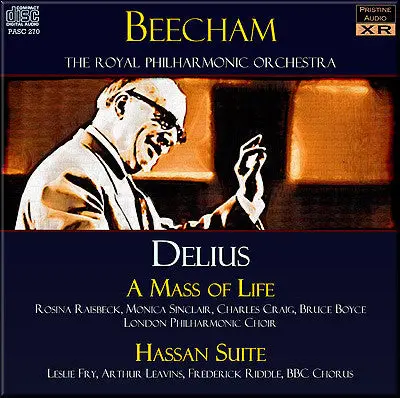
Description
overviewfb55cd020f0643f08418183279e63a5f
DELIUS A Mass of Life
DELIUS Hassan Suite
Recorded London 1952/3 and 1956
Total duration: 2hr 11:20
Soloists and Choirs
Royal Philharmonic Orchestra
conductor Sir Thomas Beecham
578a9379d1e540bd96d26f03a79628d9review_titlefb55cd020f0643f08418183279e63a5f578a9379d1e540bd96d26f03a79628d9review_quotefb55cd020f0643f08418183279e63a5f578a9379d1e540bd96d26f03a79628d9review_bodyfb55cd020f0643f08418183279e63a5f578a9379d1e540bd96d26f03a79628d9main_samplefb55cd020f0643f08418183279e63a5fsamples/PASC270.mp3578a9379d1e540bd96d26f03a79628d9tab1_labelfb55cd020f0643f08418183279e63a5fProducer’s Note578a9379d1e540bd96d26f03a79628d9tab1_typefb55cd020f0643f08418183279e63a5fcontent578a9379d1e540bd96d26f03a79628d9tab1_contentfb55cd020f0643f08418183279e63a5f
Beecham’s “A Mass of Life”: still “perfect” after nearly 60 years
Stunning new XR remasters of two classic recordings of Delius’s masterpieces
Both of these recordings were taken from Philips/Fontana white label test pressings in near-mint condition. My main aim in the remastering of them was to bring to the recordings the extra warmth and life which XR remastering and Ambient Stereo processing offers. Although both were highly competent recordings of their era, both sound a little dull and flat to the modern ear in their original incarnations, something which these new transfers and remasterings endeavour to remedy.
Andrew Rose
578a9379d1e540bd96d26f03a79628d9tab1_cover_thumbnail1_s3_locationfb55cd020f0643f08418183279e63a5f578a9379d1e540bd96d26f03a79628d9tab1_cover_thumbnail2_s3_locationfb55cd020f0643f08418183279e63a5f578a9379d1e540bd96d26f03a79628d9tab1_cover_download_s3_locationfb55cd020f0643f08418183279e63a5f578a9379d1e540bd96d26f03a79628d9tab1_sample1_s3_locationfb55cd020f0643f08418183279e63a5f578a9379d1e540bd96d26f03a79628d9tab1_sample2_s3_locationfb55cd020f0643f08418183279e63a5f578a9379d1e540bd96d26f03a79628d9tab1_sample3_s3_locationfb55cd020f0643f08418183279e63a5f578a9379d1e540bd96d26f03a79628d9tab1_sample4_s3_locationfb55cd020f0643f08418183279e63a5f578a9379d1e540bd96d26f03a79628d9tab1_sample5_s3_locationfb55cd020f0643f08418183279e63a5f578a9379d1e540bd96d26f03a79628d9tab1_sample6_s3_locationfb55cd020f0643f08418183279e63a5f578a9379d1e540bd96d26f03a79628d9tab2_labelfb55cd020f0643f08418183279e63a5fFull Track Listing578a9379d1e540bd96d26f03a79628d9tab2_typefb55cd020f0643f08418183279e63a5ftrack_listing578a9379d1e540bd96d26f03a79628d9tab2_contentfb55cd020f0643f08418183279e63a5f
- DELIUS A Mass of Life (Eine Messe des Lebens)
Recorded at Abbey Road Studio 1, London, 8 & 11 November, 8, 10, 12 & 13 December 1952,
1 & 20 January, 10 April, 14 May 1953
Rosina Raisbeck, soprano
Monica Sinclair, alto
Charles Craig, tenor
Bruce Boyce, bass
London Philharmonic Choir
(chorus-master: Frederick Jackson) - DELIUS Hassan Suite
Recorded at Walthamstow Assembly Halls, London, 29 May 1956
Leslie Fry, baritone
Arthur Leavins, violin
Frederick Riddle, viola
BBC Chorus
(chorus-master: Leslie Woodgate)
Royal Philharmonic Orchestra
conductor Sir Thomas Beecham
All transfers from Philips and Fontana white label LP test pressings
XR remastering by Andrew Rose at Pristine Audio, January 2011
Cover artwork based on a photograph of Beecham
Total duration: 2hr 11:20
578a9379d1e540bd96d26f03a79628d9tab2_cover_thumbnail1_s3_locationfb55cd020f0643f08418183279e63a5f578a9379d1e540bd96d26f03a79628d9tab2_cover_thumbnail2_s3_locationfb55cd020f0643f08418183279e63a5f578a9379d1e540bd96d26f03a79628d9tab2_cover_download_s3_locationfb55cd020f0643f08418183279e63a5f578a9379d1e540bd96d26f03a79628d9tab2_sample1_s3_locationfb55cd020f0643f08418183279e63a5f578a9379d1e540bd96d26f03a79628d9tab2_sample2_s3_locationfb55cd020f0643f08418183279e63a5f578a9379d1e540bd96d26f03a79628d9tab2_sample3_s3_locationfb55cd020f0643f08418183279e63a5f578a9379d1e540bd96d26f03a79628d9tab2_sample4_s3_locationfb55cd020f0643f08418183279e63a5f578a9379d1e540bd96d26f03a79628d9tab2_sample5_s3_locationfb55cd020f0643f08418183279e63a5f578a9379d1e540bd96d26f03a79628d9tab2_sample6_s3_locationfb55cd020f0643f08418183279e63a5f578a9379d1e540bd96d26f03a79628d9tab3_labelfb55cd020f0643f08418183279e63a5fCover Art578a9379d1e540bd96d26f03a79628d9tab3_typefb55cd020f0643f08418183279e63a5fcover_art578a9379d1e540bd96d26f03a79628d9tab3_contentfb55cd020f0643f08418183279e63a5f578a9379d1e540bd96d26f03a79628d9tab3_cover_thumbnail1_s3_locationfb55cd020f0643f08418183279e63a5fcovers/thumbs/PASC270.jpg578a9379d1e540bd96d26f03a79628d9tab3_cover_thumbnail2_s3_locationfb55cd020f0643f08418183279e63a5f578a9379d1e540bd96d26f03a79628d9tab3_cover_download_s3_locationfb55cd020f0643f08418183279e63a5fcovers/PASC270.pdf578a9379d1e540bd96d26f03a79628d9tab3_sample1_s3_locationfb55cd020f0643f08418183279e63a5f578a9379d1e540bd96d26f03a79628d9tab3_sample2_s3_locationfb55cd020f0643f08418183279e63a5f578a9379d1e540bd96d26f03a79628d9tab3_sample3_s3_locationfb55cd020f0643f08418183279e63a5f578a9379d1e540bd96d26f03a79628d9tab3_sample4_s3_locationfb55cd020f0643f08418183279e63a5f578a9379d1e540bd96d26f03a79628d9tab3_sample5_s3_locationfb55cd020f0643f08418183279e63a5f578a9379d1e540bd96d26f03a79628d9tab3_sample6_s3_locationfb55cd020f0643f08418183279e63a5f578a9379d1e540bd96d26f03a79628d9tab4_labelfb55cd020f0643f08418183279e63a5fHistoric Review578a9379d1e540bd96d26f03a79628d9tab4_typefb55cd020f0643f08418183279e63a5fcontent578a9379d1e540bd96d26f03a79628d9tab4_contentfb55cd020f0643f08418183279e63a5f
REVIEW: THE GRAMOPHONE, NOVEMBER 1953
Whether Nietzsche’s poetry has any value or not I neither know nor care (the English translation in the vocal score makes no sense at all) but I am only grateful that it provided Delius with the images of the will of man and eternity, night and day, dance and song, and so forth, that caused him to compose this great and glorious work, which is all that matters.
The Mass of Life has always been dear to Sir Thomas Beecham and I remember well the first time I heard him conduct it, at the close of the Delius Festival in 1929, and the tremendous impression it at once made on me. Now he gives a truly inspired performance which probably surpasses that one, and will, I am certain, remain one of the finest things in the repertoire of the gramophone record. The hazards are as great in this work (perhaps even greater) as in the choral finale of the Ninth Symphony, and even under Sir Thomas a choir unable to meet all the demands, or an unintelligent baritone soloist, could wreck it. I hope Bruce Boyce will not misunderstand me if I say that, fine artist though I knew him to be, I did not know he could rise to the heights he does in this performance. It is not only that he sings the difficult and trying part with complete ease and any lack of strain, but that he sings it with such a depth of conviction and intensity of emotion. As for the London Philharmonic Choir, I feel that if Delius were alive he would write a letter to them and to Frederick Jackson similar to the ones he wrote to the Philharmonic Choir in 1929 and to its trainer, Kennedy Scott, in which he praised Kennedy Scott’s great achievement” and their ” really magnificent singing.” ” I have never heard my works sung so subtly and with such fine nuance.” These tributes from one slow to praise are also deserved, it seems to me, by Mr. Jackson and his choir.
What little the other soloists have to do is well done, though the contralto’s lovely address to Zarathustra needs richer tone than Monica Sinclair provides. Charles Craig has a small voice of lyrical sweetness and Rosina Raisbeck sings the exquisite end of the third part, “they sighed and wept together” with lovely quiet tone. All the soloists are used in the last great chorus, “O man, mark well what tolls the solemn midnight bell,” and here the soprano’s voice tells well above the chorus sopranos.
The orchestral playing, needless to say, is of the finest quality throughout and the engineers are to be warmly congratulated on the superb recording of it they have achieved. It can have been no easy task to secure so good a balance and to contain the huge climaxes of vocal and orchestral tone in the magnificent opening hymn to the will of man and in the Finale. Most splendid of all is the section called “On the Mountains” (Side 2), in which the recording catches so much of the thrilling and exhilarating spirit of the music and also of the poetical picture painted by the orchestra (with the horns prominent) before the great cry with which the chorus enter. Another grand hit of recording comes after the second dance song (Side 3) (the one part of the work I do not like, for the same reason that I do not care for the Flower Maidens’ chorus in Parsifal) where Zarathustra grows sad as evening falls. The penetrating sadness of the orchestral postlude, perhaps the loveliest page in the work, comes out with perfect fidelity. Very fine, too, is the orchestral prelude to the chorus following in which the oboe solo is beautifully played and recorded.
No doubt the sleeves will give all the information required about the text and divisions of the work, and there is also a helpful analysis in Warlock’s biography of Delius. The huge debt that music-lovers of my generation owe to Sir Thomas Beecham is increased by this truly magnificent issue, one I shall, I know, play over again and again. Delius was wont to say, as he listened to broadcasts of his music from London, “Perfect, Thomas, perfect,” and, with all due respect, that is just what I want to say at the end of this review.
578a9379d1e540bd96d26f03a79628d9tab4_cover_thumbnail1_s3_locationfb55cd020f0643f08418183279e63a5f578a9379d1e540bd96d26f03a79628d9tab4_cover_thumbnail2_s3_locationfb55cd020f0643f08418183279e63a5f578a9379d1e540bd96d26f03a79628d9tab4_cover_download_s3_locationfb55cd020f0643f08418183279e63a5f578a9379d1e540bd96d26f03a79628d9tab4_sample1_s3_locationfb55cd020f0643f08418183279e63a5f578a9379d1e540bd96d26f03a79628d9tab4_sample2_s3_locationfb55cd020f0643f08418183279e63a5f578a9379d1e540bd96d26f03a79628d9tab4_sample3_s3_locationfb55cd020f0643f08418183279e63a5f578a9379d1e540bd96d26f03a79628d9tab4_sample4_s3_locationfb55cd020f0643f08418183279e63a5f578a9379d1e540bd96d26f03a79628d9tab4_sample5_s3_locationfb55cd020f0643f08418183279e63a5f578a9379d1e540bd96d26f03a79628d9tab4_sample6_s3_locationfb55cd020f0643f08418183279e63a5f
Explore more from our collection.



Reviews
There are no reviews yet.