Description
overviewfb55cd020f0643f08418183279e63a5f
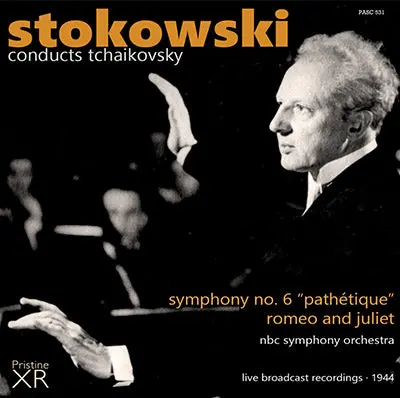
TCHAIKOVSKY Symphony No. 6 ‘Pathétique’
TCHAIKOVSKY Romeo and Juliet
Live broadcast recordings, 1944
Total duration: 67:29
NBC Symphony Orchestra
conducted by Leopold Stokowski
578a9379d1e540bd96d26f03a79628d9review_titlefb55cd020f0643f08418183279e63a5f578a9379d1e540bd96d26f03a79628d9review_quotefb55cd020f0643f08418183279e63a5f578a9379d1e540bd96d26f03a79628d9review_bodyfb55cd020f0643f08418183279e63a5f578a9379d1e540bd96d26f03a79628d9main_samplefb55cd020f0643f08418183279e63a5fsamples/PASC531.mp3578a9379d1e540bd96d26f03a79628d9tab1_labelfb55cd020f0643f08418183279e63a5fProducer’s Note578a9379d1e540bd96d26f03a79628d9tab1_typefb55cd020f0643f08418183279e63a5fcontent578a9379d1e540bd96d26f03a79628d9tab1_contentfb55cd020f0643f08418183279e63a5f
These two 1944 recordings continue to astound me weeks after I first heard them. Culled from the same source which provided us with Stokowski’s 1942 Shostakovich “Leningrad” Symphony (PASC527) they again confound expectations as to what a recording of this vintage should sound like.
Here we find Stokowski conducting the brilliant NBC Symphony Orchestra in stunning renditions of Tchaikovsky’s 6th Symphony and Romeo and Juliet fantasy overture – made all the more so by the frankly incredible sound quality of the recordings. At times, stereo aside, one might be forgiven for thinking some of these recordings had been made last week, rather than nearly three-quarters of a century ago.
Naturally they weren’t originally quite this good. Pitch jumps in the symphony had to be corrected, clicks and scratches evened out, and Pristine’s XR remastering system employed to accurately re-equalise the sound and bring out the full glory of the NBC orchestra.
With a full frequency range, exceptionally quiet sides allowing an extraordinarily wide dynamic range, and very little in the way of other flaws or audience noise to get in the way of the listening experience, one is almost immediately drawn into the performances – and they are white hot, as Edward Johnson’s excellent sleevenotes explain.
Andrew Rose578a9379d1e540bd96d26f03a79628d9tab1_cover_thumbnail1_s3_locationfb55cd020f0643f08418183279e63a5f578a9379d1e540bd96d26f03a79628d9tab1_cover_thumbnail2_s3_locationfb55cd020f0643f08418183279e63a5f578a9379d1e540bd96d26f03a79628d9tab1_cover_download_s3_locationfb55cd020f0643f08418183279e63a5f578a9379d1e540bd96d26f03a79628d9tab1_sample1_s3_locationfb55cd020f0643f08418183279e63a5f578a9379d1e540bd96d26f03a79628d9tab1_sample2_s3_locationfb55cd020f0643f08418183279e63a5f578a9379d1e540bd96d26f03a79628d9tab1_sample3_s3_locationfb55cd020f0643f08418183279e63a5f578a9379d1e540bd96d26f03a79628d9tab1_sample4_s3_locationfb55cd020f0643f08418183279e63a5f578a9379d1e540bd96d26f03a79628d9tab1_sample5_s3_locationfb55cd020f0643f08418183279e63a5f578a9379d1e540bd96d26f03a79628d9tab1_sample6_s3_locationfb55cd020f0643f08418183279e63a5f578a9379d1e540bd96d26f03a79628d9tab2_labelfb55cd020f0643f08418183279e63a5fFull Track Listing578a9379d1e540bd96d26f03a79628d9tab2_typefb55cd020f0643f08418183279e63a5ftrack_listing578a9379d1e540bd96d26f03a79628d9tab2_contentfb55cd020f0643f08418183279e63a5f
STOKOWSKI conducts Tchaikovsky
1. TCHAIKOVSKY Romeo and Juliet – Fantasy Overture (20:34)
TCHAIKOVSKY Symphony No. 6 in B minor, Op. 74 “Pathétique”
2. 1st mvt. – Adagio – Allegro non troppo (19:39)
3. 2nd mvt. – Allegro con grazia (8:04)
4. 3rd mvt. – Allegro molto vivace (8:20)
5. 4th mvt. – Adagio lamentoso (10:52)
NBC Symphony Orchestra
conducted by Leopold Stokowski
Total duration: 67:29
XR remastering by Andrew Rose
Cover artwork based on a photograph of Stokowski
Tchaikovsky Romeo & Juliet
Broadcast of 16 January 1944
Tchaikovsky Symphony No. 6
Broadcast of 30 January 1944
Live broadcast concerts from RCA Studio 8H, Radio City, New York City
Total duration: 67:29
578a9379d1e540bd96d26f03a79628d9tab2_cover_thumbnail1_s3_locationfb55cd020f0643f08418183279e63a5f578a9379d1e540bd96d26f03a79628d9tab2_cover_thumbnail2_s3_locationfb55cd020f0643f08418183279e63a5f578a9379d1e540bd96d26f03a79628d9tab2_cover_download_s3_locationfb55cd020f0643f08418183279e63a5f578a9379d1e540bd96d26f03a79628d9tab2_sample1_s3_locationfb55cd020f0643f08418183279e63a5f578a9379d1e540bd96d26f03a79628d9tab2_sample2_s3_locationfb55cd020f0643f08418183279e63a5f578a9379d1e540bd96d26f03a79628d9tab2_sample3_s3_locationfb55cd020f0643f08418183279e63a5f578a9379d1e540bd96d26f03a79628d9tab2_sample4_s3_locationfb55cd020f0643f08418183279e63a5f578a9379d1e540bd96d26f03a79628d9tab2_sample5_s3_locationfb55cd020f0643f08418183279e63a5f578a9379d1e540bd96d26f03a79628d9tab2_sample6_s3_locationfb55cd020f0643f08418183279e63a5f578a9379d1e540bd96d26f03a79628d9tab3_labelfb55cd020f0643f08418183279e63a5fCover Art578a9379d1e540bd96d26f03a79628d9tab3_typefb55cd020f0643f08418183279e63a5fcover_art578a9379d1e540bd96d26f03a79628d9tab3_contentfb55cd020f0643f08418183279e63a5f
578a9379d1e540bd96d26f03a79628d9tab3_cover_thumbnail1_s3_locationfb55cd020f0643f08418183279e63a5f578a9379d1e540bd96d26f03a79628d9tab3_cover_thumbnail2_s3_locationfb55cd020f0643f08418183279e63a5f578a9379d1e540bd96d26f03a79628d9tab3_cover_download_s3_locationfb55cd020f0643f08418183279e63a5fcovers/PASC531.pdf578a9379d1e540bd96d26f03a79628d9tab3_sample1_s3_locationfb55cd020f0643f08418183279e63a5f578a9379d1e540bd96d26f03a79628d9tab3_sample2_s3_locationfb55cd020f0643f08418183279e63a5f578a9379d1e540bd96d26f03a79628d9tab3_sample3_s3_locationfb55cd020f0643f08418183279e63a5f578a9379d1e540bd96d26f03a79628d9tab3_sample4_s3_locationfb55cd020f0643f08418183279e63a5f578a9379d1e540bd96d26f03a79628d9tab3_sample5_s3_locationfb55cd020f0643f08418183279e63a5f578a9379d1e540bd96d26f03a79628d9tab3_sample6_s3_locationfb55cd020f0643f08418183279e63a5f578a9379d1e540bd96d26f03a79628d9tab4_labelfb55cd020f0643f08418183279e63a5fSleevenotes578a9379d1e540bd96d26f03a79628d9tab4_typefb55cd020f0643f08418183279e63a5fcontent578a9379d1e540bd96d26f03a79628d9tab4_contentfb55cd020f0643f08418183279e63a5f
Inthe spring of 1941, for a great many reasons, Toscanini decided notto renew his contract for the NBC Symphony’s winter season. However,he did leave the door open for an eventual return to the orchestrathat had been specially created for him, so plans were duly set inmotion for its continuation.
Atthat time, Stokowski was reaching a wide public outside the concerthall with his appearance in Walt Disney’s “Fantasia.” Hislong tenure with the Philadelphia Orchestra had come to an end andhis formation in 1940 of the short-lived All-American Youth Orchestrakept him busy during the summers. This left him free for the winterperiods, so he was duly engaged to conduct the NBC Symphony on athree-year contract, commencing with the 1941-42 season.
AmongStokowski’s many interests was a study of acoustics and he soonrecommended the installation of diffusers and reflectors inthe notoriously dead-sounding Studio 8-H. Time magazinereported the delight of audience and critics alike, adding that “thereverberations were all they should be; radio’s biggest concerthall had at last become musicianly.” Stokowski was also a greatchampion of modern music andit was once estimated that over a 60-year conducting career he’dgiven around 2,000 “first performances” of one sort oranother. His three NBC seasons typified his advocacy of new music,particularly of works by American composers.
However,Stokowski didn’t neglect the classics and Tchaikovsky was high on thelist of past composers whose music he loved to perform. Indeed, the’March’ from the “Pathetique” Symphony, acting as a kind of’overture’, was the first item on his conducting debut programme withthe Colonne Orchestra in Paris in 1909.
Hismove to Philadelphia in 1912 saw Stokowski turning the city’sorchestra into one of the world’s finest and when he began makingacoustic 78s, several Tchaikovsky numbers, including the “Pathetique”‘March,’ were duly inscribed on disc (PASC 441). With the advent ofelectrical recording, Stokowski made the first American 78s ofvarious Tchaikovsky works, including “Romeo and Juliet” in1928. It is clear that he’d read in Modest Tchaikovsky’s “Lifeand Letters” a complaint from Balakirev that the loudaccentuated chords at the end were “inartistic.” Modestadds that in his final version, Tchaikovsky “omitted thesechords himself” but as no such edition has ever been published -and there were already three different versions of the work -Stokowski provided a ‘quiet ending’ of his own!
Itremains only to note that Toscanini soon recovered from the malaisethat had affected him and returned as Stokowski’s NBC co-conductorfor the remaining two seasons of the latter’s contract. David Hall’scomment that “the most spectacular combination ofperformance and programming were the two Toscanini-Stokowskiseasons” is born out in the surviving recordings of theirbroadcasts. For his part, as will be heard in these Tchaikovskyworks, Stokowski’s readings took on the kind of white-hot, whiplashintensity – string portamentos notwithstanding!- that characterisedToscanini’s performances, whilst in turn, the great Italian maestroprogrammed more American works during his co-conductorship withStokowski than at any other time during his own long career. It doesrather look as if these two great maestros, although quite differentin so many ways, came under each other’s considerable influenceduring those two legendary NBC seasons.
Edward Johnson
578a9379d1e540bd96d26f03a79628d9tab4_cover_thumbnail1_s3_locationfb55cd020f0643f08418183279e63a5f578a9379d1e540bd96d26f03a79628d9tab4_cover_thumbnail2_s3_locationfb55cd020f0643f08418183279e63a5f578a9379d1e540bd96d26f03a79628d9tab4_cover_download_s3_locationfb55cd020f0643f08418183279e63a5f578a9379d1e540bd96d26f03a79628d9tab4_sample1_s3_locationfb55cd020f0643f08418183279e63a5f578a9379d1e540bd96d26f03a79628d9tab4_sample2_s3_locationfb55cd020f0643f08418183279e63a5f578a9379d1e540bd96d26f03a79628d9tab4_sample3_s3_locationfb55cd020f0643f08418183279e63a5f578a9379d1e540bd96d26f03a79628d9tab4_sample4_s3_locationfb55cd020f0643f08418183279e63a5f578a9379d1e540bd96d26f03a79628d9tab4_sample5_s3_locationfb55cd020f0643f08418183279e63a5f578a9379d1e540bd96d26f03a79628d9tab4_sample6_s3_locationfb55cd020f0643f08418183279e63a5f
Explore more from our collection.


Reviews
There are no reviews yet.