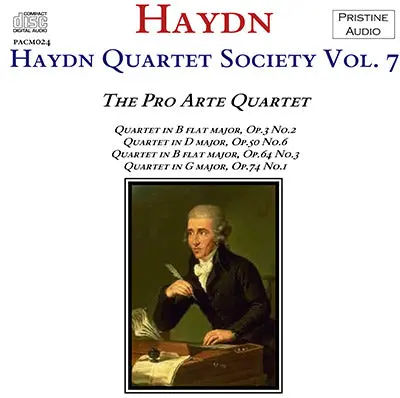
Description
overviewfb55cd020f0643f08418183279e63a5fHAYDN String Quartet in B flat major, Op.3 No.4, Hob.III:16
HAYDN String Quartet in D major, Op.50 No.6, Hob.III:27 “The Frog”
HAYDN String Quartet in B flat major, Op.64 No.3, Hob.III:67 “Tost II”
HAYDN String Quartet in G major, Op.74 No.1, Hob.III:72 “Apponyi”
Recorded Abbey Road Studio 3, London
Recorded in 1937
Duration 57:36
578a9379d1e540bd96d26f03a79628d9review_titlefb55cd020f0643f08418183279e63a5fBill Rosen’s Review578a9379d1e540bd96d26f03a79628d9review_quotefb55cd020f0643f08418183279e63a5fThe combined artistry of Joseph Haydn, the Pro Arte Quartet and Pristine Audio continue at a very high level578a9379d1e540bd96d26f03a79628d9review_bodyfb55cd020f0643f08418183279e63a5f
The combined artistry of Joseph Haydn, the Pro Arte Quartet and Pristine Audio continue at a very high level in this seventh and penultimate volume of the series. I have already used up all my adjectives of praise in describing the performances and the sound reprocessing and I will confine myself to the music.
Op. 3 #4
There is youthful Haydn, but there is no immature Haydn. A very melodious movement starts with a swinging theme and presenting a quite regular sonata form. Too early for Haydn’s tricks. The second movement features a chordal theme alternating twice with a fast allegro. Just two movements.
Op. 50 #6
A very moderate allegro opening leads to a modulating development and a regular recapitulation. A fast moving andante is beautiful but rather conventional. A bright minuet leads to a finale made from a wisp of a theme based on rapid repeated notes. Maybe not a top drawer Haydn opus, but worth hearing.
Op. 64 #3
An assertive opening theme which gives way to a wide-ranging lyrical theme opens the quartet. The development is fascinating with its gallaping rhythm and an exciting recapititulation. The andante is very beautiful with interesting modulations at the nd. A very vigorous minuet with a drone-bass trio leads to a kaleidescopic presto finale, filled with suprise modulations.
Op. 74 #1
A masterpiece! An entire first movement based on an opening 4-note theme put through every conceivable development device. A lovely, relaxed, lyrical andante. An emphatic yet droll minuet leading to an allegro molto finale ending with some powerful drone basses.
Were some catastrophe to happen to Western Civilization and were only this Haydn/Pro Arte series left, I am confident that a music student of the 40th century would find enough here to understand the Classic Era.
578a9379d1e540bd96d26f03a79628d9main_samplefb55cd020f0643f08418183279e63a5fsamples/PACM024.mp3578a9379d1e540bd96d26f03a79628d9tab1_labelfb55cd020f0643f08418183279e63a5fProducer’s Note578a9379d1e540bd96d26f03a79628d9tab1_typefb55cd020f0643f08418183279e63a5fcontent578a9379d1e540bd96d26f03a79628d9tab1_contentfb55cd020f0643f08418183279e63a5f
Seventh Volume of The Haydn Quartet Society
The Pro Arte Quartet, remastered for finest sound quality
To state that Haydn, more than perhaps any other composer, is responsible for the String Quartet as we know it – and from there the many other instrumental variations of chamber music of the Classical, Romantic and Modern periods – seems a very bold and sweeping comment. And yet it was Haydn who freed his quartets from the tyranny of the continuo and allowed his parts to move freely, without relying on the ‘gravity’ of a bass. It was Haydn who more or less invented Sonata form, and who developed the beautiful part-writing, following on from his own studies into earlier vocal polyphony, which is the essence of the string quartet medium.
Of his many quartets – one website lists 78 works for String Quartet by or attributed to Haydn – the Pro Arte Quartet chose 29 works to record in their ground-breaking 8-volume Haydn Quartet Society series, made for HMV between 1931 and 1938. These cover the full range of his output, from Op. 1 No. 1 (1762) to the two Opus 77 quartets of 1799 (the final Op. 103 remained unfinished).
Andrew Rose
578a9379d1e540bd96d26f03a79628d9tab1_cover_thumbnail1_s3_locationfb55cd020f0643f08418183279e63a5f578a9379d1e540bd96d26f03a79628d9tab1_cover_thumbnail2_s3_locationfb55cd020f0643f08418183279e63a5f578a9379d1e540bd96d26f03a79628d9tab1_cover_download_s3_locationfb55cd020f0643f08418183279e63a5f578a9379d1e540bd96d26f03a79628d9tab1_sample1_s3_locationfb55cd020f0643f08418183279e63a5f578a9379d1e540bd96d26f03a79628d9tab1_sample2_s3_locationfb55cd020f0643f08418183279e63a5f578a9379d1e540bd96d26f03a79628d9tab1_sample3_s3_locationfb55cd020f0643f08418183279e63a5f578a9379d1e540bd96d26f03a79628d9tab1_sample4_s3_locationfb55cd020f0643f08418183279e63a5f578a9379d1e540bd96d26f03a79628d9tab1_sample5_s3_locationfb55cd020f0643f08418183279e63a5f578a9379d1e540bd96d26f03a79628d9tab1_sample6_s3_locationfb55cd020f0643f08418183279e63a5f578a9379d1e540bd96d26f03a79628d9tab2_labelfb55cd020f0643f08418183279e63a5fFull Track Listing578a9379d1e540bd96d26f03a79628d9tab2_typefb55cd020f0643f08418183279e63a5ftrack_listing578a9379d1e540bd96d26f03a79628d9tab2_contentfb55cd020f0643f08418183279e63a5f
-
HAYDN String Quartet in B flat major, Op.3 No.4, Hob.III:16
-
HAYDN String Quartet in D major, Op.50 No.6, Hob.III:27 “The Frog”
-
HAYDN String Quartet in B flat major, Op.64 No.3, Hob.III:67 “Tost II”
-
HAYDN String Quartet in G major, Op.74 No.1, Hob.III:72 “Apponyi”
Recorded Abbey Road Studio 3, London
Recorded in 1937, released as HMV 78s, D.B.3543-549
Matrix numbers: 2EA: 5584-85, 5568-71, 5576-79, 5572-75
Takes: 1,1,2,1,1,1,2,2,1,1,3,2,1,2
Download ID: 177481
Duration 57:36
The Pro Arte Quartet:
Alphonse Onnou, violin
Laurent Halleux, violin
Germain Prevost, viola
Robert Maas, cello
578a9379d1e540bd96d26f03a79628d9tab2_cover_thumbnail1_s3_locationfb55cd020f0643f08418183279e63a5f578a9379d1e540bd96d26f03a79628d9tab2_cover_thumbnail2_s3_locationfb55cd020f0643f08418183279e63a5f578a9379d1e540bd96d26f03a79628d9tab2_cover_download_s3_locationfb55cd020f0643f08418183279e63a5f578a9379d1e540bd96d26f03a79628d9tab2_sample1_s3_locationfb55cd020f0643f08418183279e63a5f578a9379d1e540bd96d26f03a79628d9tab2_sample2_s3_locationfb55cd020f0643f08418183279e63a5f578a9379d1e540bd96d26f03a79628d9tab2_sample3_s3_locationfb55cd020f0643f08418183279e63a5f578a9379d1e540bd96d26f03a79628d9tab2_sample4_s3_locationfb55cd020f0643f08418183279e63a5f578a9379d1e540bd96d26f03a79628d9tab2_sample5_s3_locationfb55cd020f0643f08418183279e63a5f578a9379d1e540bd96d26f03a79628d9tab2_sample6_s3_locationfb55cd020f0643f08418183279e63a5f578a9379d1e540bd96d26f03a79628d9tab3_labelfb55cd020f0643f08418183279e63a5fCover Art578a9379d1e540bd96d26f03a79628d9tab3_typefb55cd020f0643f08418183279e63a5fcover_art578a9379d1e540bd96d26f03a79628d9tab3_contentfb55cd020f0643f08418183279e63a5f578a9379d1e540bd96d26f03a79628d9tab3_cover_thumbnail1_s3_locationfb55cd020f0643f08418183279e63a5fcovers/thumbs/PACM024.jpg578a9379d1e540bd96d26f03a79628d9tab3_cover_thumbnail2_s3_locationfb55cd020f0643f08418183279e63a5f578a9379d1e540bd96d26f03a79628d9tab3_cover_download_s3_locationfb55cd020f0643f08418183279e63a5fcovers/PACM024.pdf578a9379d1e540bd96d26f03a79628d9tab3_sample1_s3_locationfb55cd020f0643f08418183279e63a5f578a9379d1e540bd96d26f03a79628d9tab3_sample2_s3_locationfb55cd020f0643f08418183279e63a5f578a9379d1e540bd96d26f03a79628d9tab3_sample3_s3_locationfb55cd020f0643f08418183279e63a5f578a9379d1e540bd96d26f03a79628d9tab3_sample4_s3_locationfb55cd020f0643f08418183279e63a5f578a9379d1e540bd96d26f03a79628d9tab3_sample5_s3_locationfb55cd020f0643f08418183279e63a5f578a9379d1e540bd96d26f03a79628d9tab3_sample6_s3_locationfb55cd020f0643f08418183279e63a5f
Explore more from our collection.


Reviews
There are no reviews yet.